Question 1(a)
DifferentiationDifferentiate
Show answerHide answer
Show marking instructionsHide marking instructions
Question 1(a)
•¹ evidence of use of product rule
•² one resultant term of the product correct
or
•³ complete differentiation
Advanced Higher Maths · SQA past paper
Differentiate
•¹ evidence of use of product rule
•² one resultant term of the product correct
or
•³ complete differentiation
Given , find , simplifying your answer.
•⁴ evidence of use of quotient or product rule and one term of numerator correct
•⁵ complete differentiation correctly
or
•⁶ simplify answer
A curve is given by the parametric equations and
Find in terms of
•⁷ correct derivatives
and
•⁸ find
A geometric sequence has second and fifth terms 108 and 4 respectively.
(a)Calculate the value of the common ratio.
(b)State why the associated geometric series has a sum to infinity.
(c)Find the value of this sum to infinity.
•¹ interpret geometric series
and
•² evidence of strategy
OR
•³ value
•⁴ know condition
•⁵ calculate the first term
•⁶ value
leading to
Write down and simplify the general term in the binomial expansion of
Hence, or otherwise, find the term in
•¹ state general term
•² simplify powers of x OR coefficients
or
•³ state simplified general term
•⁴ determine value of r
•⁵ evaluate term
Below is a system of equations:
Use Gaussian elimination to find the value of which leads to redundancy.
•¹ Construct augmented matrix
•² Use row operations to establish first two zero elements
•³ Establish third zero element OR recognise linear relationship between two rows
OR
•⁴ State value of
Prove by induction that ,
•¹ show true for
LHS: RHS: So true for
•² assume true for AND consider
and
•³ correct statement of sum to terms using inductive hypothesis
•⁴ express explicitly in terms of or achieve stated aim/goal AND communicate
, thus if true for then true for but since true for , then by induction true for all
Find Maclaurin expansions for and up to and including the term in
Hence obtain an expansion for up to and including the term in
•¹ for either function: first derivative and two evaluations OR all three derivatives OR all four evaluations
,
,
,
,
•² complete derivatives and evaluations AND substitute
•³ for second function: first derivative and two evaluations OR all three derivatives OR all four evaluations
,
,
,
,
•⁴ complete derivatives and evaluations AND substitute
•⁵ multiply expressions
•⁶ multiply out and simplify
A is the matrix
(a)Find the determinant of matrix A.
(b)Show that can be expressed in the form , stating the values of and
(c)Obtain a similar expression for
•¹ calculate determinant
•² find
•³ use an appropriate method
•⁴ write in required form and explicitly state values of p and q
and
•⁵ square expression found in (b)
•⁶ substitute for and complete process
Let
(a)Plot on an Argand diagram.
(b)Let where ,
Express in polar form.
(c)Express in the form where
•¹ correctly plot z on Argand diagram
Point in quadrant 4 with coordinates/labels for and
•² find modulus or argument
or
•³ complete and express in polar form
•⁴ process modulus
•⁵ process argument
•⁶ evaluate and express in form
Obtain
•¹ know to use integration by parts and start process
•² correct choice of functions to differentiate and integrate AND application thereof
•³ differentiate
•⁴ know to use second application and begin process
•⁵ complete second application
•⁶ simplify
For each of the following statements, decide whether it is true or false.
If true, give a proof; if false, give a counterexample.
A. If a positive integer is prime, then so is
B. If a positive integer has remainder 1 when divided by 3, then also has remainder 1 when divided by 3.
•¹ give counterexample
eg. choose , and since , hence not prime, statement is false
•² set up n
,
•³ consider expansion of
•⁴ complete proof with conclusion
and statement such as "so has remainder 1 when divided by 3... statement is true"
The height of a cube is increasing at the rate of 5 cm s
Find the rate of increase of the volume when the height of the cube is 3 cm.
•¹ state differential equation
•² state relationship or apply chain rule
OR
•³ find the rate of change of volume with respect to height
•⁴ evaluate
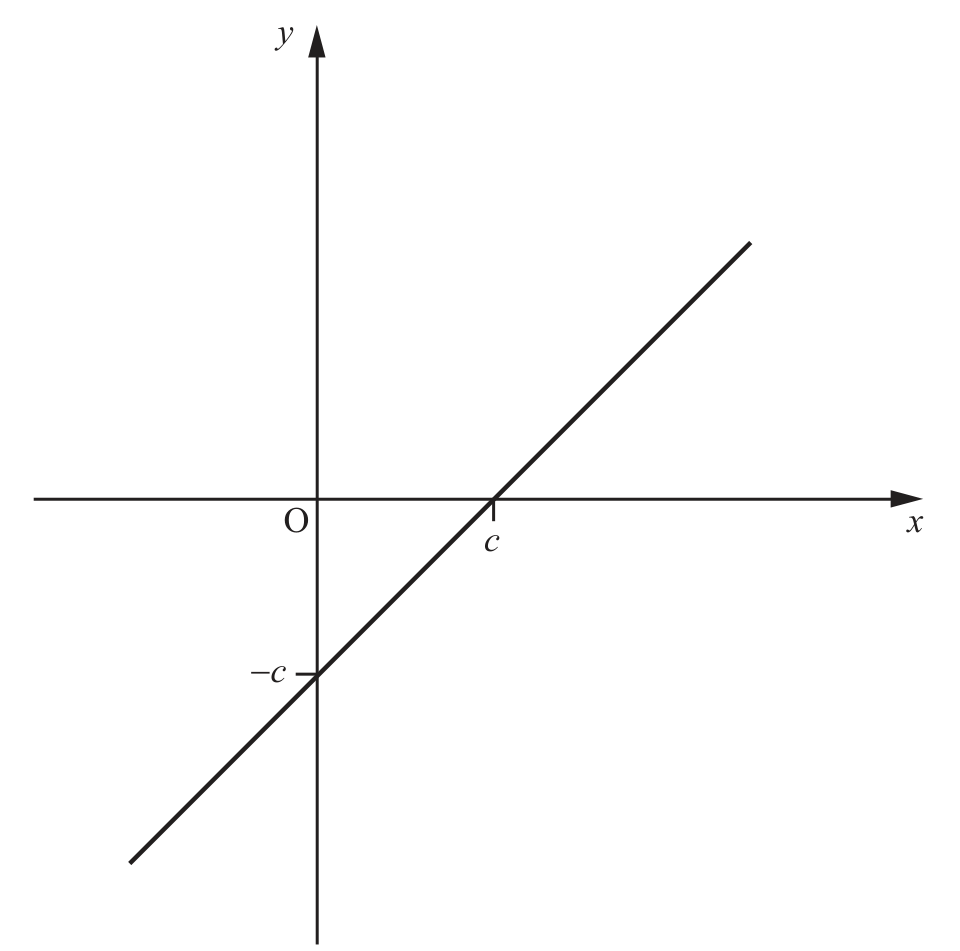
Below is a diagram showing the graph of a linear function,

On separate diagrams show:
(a)
(b)
•¹ correct shape
V shape reflecting in x-axis
•² graph passes through 2c on the positive y-axis
Passes through (0, 2c) and meets x axis at c
•³ graph of passing through 2c on the positive y-axis
Passes through on y-axis
•⁴ correct shape (symmetrical V) meeting positive x-axis at c
V shape meeting x-axis at
Express in partial fractions and hence evaluate
Give your answer in the form
•¹ correct application of partial fractions
•² starts process
•³ calculate one value
•⁴ calculate second value
•⁵ re-state integral in partial fractions
•⁶ one term correctly integrated
•⁷ Integrate second term correctly
•⁸ substitute limits
•⁹ evaluate to expected form
Two lines and are given by the equations:
(a)Show that the lines and intersect and find the point of intersection.
(b)Calculate the obtuse angle between the lines and
•¹ convert any two components of to parametric form
two from
•² two linear equations involving two distinct parameters
two from
•³ find parameter values
•⁴ verify third component in both equations or equivalent
eg and therefore the lines intersect
•⁵ find point of intersection
•⁶ identify first direction vector
•⁷ identify second direction vector
•⁸ calculate magnitudes and scalar product
and
•⁹ calculate obtuse angle
Solve the differential equation
given and , when
•¹ state auxiliary equation
•² solve auxiliary equation and state complementary function
•³ construct particular integral
•⁴ differentiate particular integral
and
•⁵ calculate one coefficient of the particular integral
•⁶ calculate remaining coefficients
•⁷ differentiate general solution
•⁸ construct equations using given conditions
and or equivalent
•⁹ Find one coefficient
or
•¹⁰ Find other coefficient and state particular solution
A beaker of liquid was placed in a fridge.
The rate of cooling is given by
, ,
where is the constant temperature in the fridge and is the temperature of the liquid at time
At what time, to the nearest minute, was the liquid placed in the fridge?
•¹ construct integral equation
•² integrate
•³ find constant, c
•⁴ substitute using given information
•⁵ find constant, k
•⁶ substitute given condition
•⁷ know how to find time
•⁸ calculate time
•⁹ state the time to the nearest minute
The liquid was placed in the fridge at 11:37 (am)