Advanced Higher Maths · SQA past paper

2017 Paper 1

Calculator allowed · 18 questions
1

Question 1

Binomial Theorem
4 Marks
2017 Q1

Write down the binomial expansion of (2y25y)3\displaystyle \left(\frac{2}{y^2}-5y\right)^3 and simplify your answer.

Show answer
8y660y3+150125y3\displaystyle \frac{8}{y^6} - \frac{60}{y^3} + 150 - 125y^3
Show marking instructions

Question 1

•¹ write down binomial expansion
(30)(2y2)3+(31)(2y2)2(5y)+(32)(2y2)(5y)2+(33)(5y)3\displaystyle \binom{3}{0}(\frac{2}{y^2})^3 + \binom{3}{1}(\frac{2}{y^2})^2(-5y) + \binom{3}{2}(\frac{2}{y^2})(-5y)^2 + \binom{3}{3}(-5y)^3

•² resolve signs, •³ simplify coefficients or powers of y, •⁴ complete simplification and obtain expression
8y660y3+150125y3\displaystyle \frac{8}{y^6} - \frac{60}{y^3} + 150 - 125y^3

2

Question 2

Partial Fractions
4 Marks
2017 Q2

Express x26x+20(x+1)(x2)2\displaystyle \frac{x^2-6x+20}{(x+1)(x-2)^2} in partial fractions.

Show answer
3x+12x2+4(x2)2\displaystyle \frac{3}{x+1} - \frac{2}{x-2} + \frac{4}{(x-2)^2}
Show marking instructions

Question 2

•¹ state expression
x26x+20(x+1)(x2)2=A(x+1)+B(x2)+C(x2)2\displaystyle \frac{x^2-6x+20}{(x+1)(x-2)^2} = \frac{A}{(x+1)} + \frac{B}{(x-2)} + \frac{C}{(x-2)^2}

•² form equation
x26x+20=A(x2)2+B(x+1)(x2)+C(x+1)\displaystyle x^2-6x+20 = A(x-2)^2 + B(x+1)(x-2) + C(x+1)

•³ obtain two of A, B and C
A=3\displaystyle A=3, B=2\displaystyle B=-2, C=4\displaystyle C=4

•⁴ obtain final constant and state expression
3(x+1)2(x2)+4(x2)2\displaystyle \frac{3}{(x+1)} - \frac{2}{(x-2)} + \frac{4}{(x-2)^2}

3

Question 3

Differentiation
3 Marks
2017 Q3

On a suitable domain, a function is defined by f(x)=ex21x21.\displaystyle f(x)=\frac{e^{x^2-1}}{x^2-1}.
Find f(x)\displaystyle f'(x) simplifying your answer.

Show answer
2xex21(x22)(x21)2\displaystyle \frac{2xe^{x^2-1}(x^2-2)}{(x^2-1)^2}
Show marking instructions

Question 3

•¹ evidence use of quotient rule with one term of numerator correct
2xex21(x21)(x21)2\displaystyle \frac{2xe^{x^2-1}(x^2-1) - \dots}{(x^2-1)^2}

•² complete differentiation
ex21(2x)\displaystyle \dots - e^{x^2-1}(2x)

•³ simplify
2x3ex214xex21(x21)2\displaystyle \frac{2x^3e^{x^2-1}-4xe^{x^2-1}}{(x^2-1)^2}

4

Question 4

Sequences & Series
(2, 3)5 Marks
2017 Q4

The fifth term of an arithmetic sequence is 6\displaystyle -6 and the twelfth term is 34.\displaystyle -34.

(a)Determine the values of the first term and the common difference.

(b)Obtain algebraically the value of n\displaystyle n for which Sn=144.\displaystyle S_n = -144.

Show answer
(a) a=10\displaystyle a = 10, d=4\displaystyle d = -4
(b) n=12\displaystyle n = 12
Show marking instructions

Question 4(a)

•¹ evidence use of valid strategy
eg a+4d=6\displaystyle a+4d=-6 and a+11d=34\displaystyle a+11d=-34

•² obtain values of a and d
a=10\displaystyle a=10, d=4\displaystyle d=-4

Question 4(b)

•³ set up equation
n2[204(n1)]=144\displaystyle \frac{n}{2}[20-4(n-1)] = -144

•⁴ rearrange to standard form
2n212n144=0\displaystyle 2n^2-12n-144=0

•⁵ determine the value of n
n>0n=12\displaystyle n>0 \dots n=12

5

Question 5

Systems of Equations
(4, 1, 1)6 Marks
2017 Q5

(a)(i) Use Gaussian elimination on the system of equations below to give an expression for z\displaystyle z in terms of λ.\displaystyle \lambda.

x+2yz=3\displaystyle x + 2y - z = -3
4x2y+3z=11\displaystyle 4x - 2y + 3z = 11
3x+y+2λz=8\displaystyle 3x + y + 2\lambda z = 8

(ii) For what value of λ\displaystyle \lambda is this system of equations inconsistent?

(b)Determine the solution of this system when λ=2.5.\displaystyle \lambda = -2.5.

Show answer
(a)(i) z=114λ1\displaystyle z = \frac{11}{4\lambda - 1}
(a)(ii) λ=14\displaystyle \lambda = \frac{1}{4}
(b) x=2\displaystyle x = 2, y=3\displaystyle y = -3, z=1\displaystyle z = -1
Show marking instructions

Question 5(a)(i)

•¹ set up augmented matrix
(121342311312λ8)\displaystyle \begin{pmatrix} 1 & 2 & -1 & | & -3 \\ 4 & -2 & 3 & | & 11 \\ 3 & 1 & 2\lambda & | & 8 \end{pmatrix}

•² obtain two zeros
(1213010723052λ+317)\displaystyle \begin{pmatrix} 1 & 2 & -1 & | & -3 \\ 0 & -10 & 7 & | & 23 \\ 0 & -5 & 2\lambda+3 & | & 17 \end{pmatrix}

•³ complete row operations
(1213010723004λ111)\displaystyle \begin{pmatrix} 1 & 2 & -1 & | & -3 \\ 0 & -10 & 7 & | & 23 \\ 0 & 0 & 4\lambda-1 & | & 11 \end{pmatrix}

•⁴ obtain expression for z
z=114λ1\displaystyle z = \frac{11}{4\lambda-1}

Question 5(a)(ii)

•⁵ state value of λ\displaystyle \lambda
λ=14\displaystyle \lambda = \frac{1}{4}

Question 5(b)

•⁶ find solution
z=1\displaystyle z=-1, y=3\displaystyle y=-3, x=2\displaystyle x=2

6

Question 6

Integration
6 Marks
2017 Q6

Use the substitution u=5x2\displaystyle u=5x^2 to find the exact value of 0110x125x4dx.\displaystyle \int_{0}^{\frac{1}{\sqrt{10}}} \frac{x}{\sqrt{1-25x^4}} dx.

Show answer
π60\displaystyle \frac{\pi}{60}
Show marking instructions

Question 6

•¹ differentiate 5x2\displaystyle 5x^2
dudx=10x\displaystyle \frac{du}{dx} = 10x or du=10xdx\displaystyle du = 10xdx

•² find limits for u
u=0\displaystyle u=0, u=12\displaystyle u=\frac{1}{2}

•³ replace xdx\displaystyle x dx
110du\displaystyle \frac{1}{10}\int \dots du

•⁴ obtain integrand
11001/211u2du\displaystyle \frac{1}{10}\int_0^{1/2} \frac{1}{\sqrt{1-u^2}} du

•⁵ integrate
110[sin1u]01/2\displaystyle \frac{1}{10}[\sin^{-1}u]_0^{1/2}

•⁶ evaluate
π60\displaystyle \frac{\pi}{60}

7

Question 7

Matrices
(1, 1, 2, 2)6 Marks
2017 Q7

Matrices P\displaystyle P and Q\displaystyle Q are defined by P=(x251)\displaystyle P = \begin{pmatrix} x & 2 \\ -5 & -1 \end{pmatrix} and Q=(234y)\displaystyle Q = \begin{pmatrix} 2 & -3 \\ 4 & y \end{pmatrix}, where x,yR.\displaystyle x,y \in \mathbb{R}.

(a)Given the determinant of P\displaystyle P is 2, obtain:

(i) The value of x.\displaystyle x.
(ii) P1.\displaystyle P^{-1}.
(iii) P1Q\displaystyle P^{-1}Q', where Q\displaystyle Q' is the transpose of Q.\displaystyle Q.

(b)The matrix R\displaystyle R is defined by R=(52z6)\displaystyle R = \begin{pmatrix} 5 & -2 \\ z & -6 \end{pmatrix}, where zR.\displaystyle z \in \mathbb{R}.

Determine the value of z\displaystyle z such that R\displaystyle R is singular.

Show answer
(a)(i) x=8\displaystyle x = 8
(a)(ii) P1=12(1258)\displaystyle P^{-1} = \frac{1}{2}\begin{pmatrix} -1 & -2 \\ 5 & 8 \end{pmatrix}
(a)(iii) 12(442y1420+8y)\displaystyle \frac{1}{2}\begin{pmatrix} 4 & -4-2y \\ -14 & 20+8y \end{pmatrix}
(b) z=15\displaystyle z = 15
Show marking instructions

Question 7(a)(i)

•¹ determine value of x
x=8\displaystyle x=8

Question 7(a)(ii)

•² find inverse
P1=12(125x)=12(1258)\displaystyle P^{-1} = \frac{1}{2}\begin{pmatrix} -1 & -2 \\ 5 & x \end{pmatrix} = \frac{1}{2}\begin{pmatrix} -1 & -2 \\ 5 & 8 \end{pmatrix}

Question 7(a)(iii)

•³ state transpose
Q=(243y)\displaystyle Q' = \begin{pmatrix} 2 & 4 \\ -3 & y \end{pmatrix}

•⁴ obtain product
P1Q=(22y710+4y)\displaystyle P^{-1}Q' = \begin{pmatrix} 2 & -2-y \\ -7 & 10+4y \end{pmatrix} OR 12(442y1420+8y)\displaystyle \frac{1}{2}\begin{pmatrix} 4 & -4-2y \\ -14 & 20+8y \end{pmatrix}

Question 7(b)

•⁵ state condition for singularity
detR=0\displaystyle \det R = 0 or one row is a multiple of the other

•⁶ obtain value for z
z=15\displaystyle z=15

8

Question 8

Number Theory
4 Marks
2017 Q8

Use the Euclidean algorithm to find integers a\displaystyle a and b\displaystyle b such that 1595a+1218b=29.\displaystyle 1595a + 1218b = 29.

Show answer
a=13,b=17\displaystyle a = 13, b = -17
Show marking instructions

Question 8

•¹ start process
1595=1×1218+377\displaystyle 1595 = 1 \times 1218 + 377 and 1218=3×377+87\displaystyle 1218 = 3 \times 377 + 87

•² obtain remainder of 29
377=4×87+29\displaystyle 377 = 4 \times 87 + 29 and 87=3×29+0\displaystyle 87 = 3 \times 29 + 0

•³ express gcd in terms of 377 and 1218
29=3774(12183×377)\displaystyle 29 = 377 - 4(1218 - 3 \times 377)

•⁴ state values of a and b
a=13\displaystyle a=13, b=17\displaystyle b=-17

9

Question 9

Differential Equations
5 Marks
2017 Q9

Solve dydx=e2x(1+y2)\displaystyle \frac{dy}{dx} = e^{2x}(1+y^2) given that when x=0\displaystyle x=0, y=1.\displaystyle y=1.
Express y\displaystyle y in terms of x.\displaystyle x.

Show answer
y=tan(12e2x+π412)\displaystyle y = \tan\left(\frac{1}{2}e^{2x} + \frac{\pi}{4} - \frac{1}{2}\right)
Show marking instructions

Question 9

•¹ separate variables and write down integral equation
dy1+y2=e2xdx\displaystyle \int \frac{dy}{1+y^2} = \int e^{2x} dx

•² integrate LHS
tan1y\displaystyle \tan^{-1} y

•³ integrate RHS
12e2x+c\displaystyle \frac{1}{2}e^{2x} + c

•⁴ evaluate constant of integration
c=π412\displaystyle c = \frac{\pi}{4} - \frac{1}{2}

•⁵ express y in terms of x
y=tan(12e2x+π412)\displaystyle y = \tan(\frac{1}{2}e^{2x} + \frac{\pi}{4} - \frac{1}{2})

10

Question 10

Sequences & Series
(2, 2)4 Marks
2017 Q10

Sn\displaystyle S_n is defined by r=1n(r2+13r).\displaystyle \sum_{r=1}^{n}\left(r^2 + \frac{1}{3}r\right).

(a)Find an expression for Sn\displaystyle S_n, fully factorising your answer.

(b)Hence find an expression for r=102p(r2+13r)\displaystyle \sum_{r=10}^{2p}\left(r^2 + \frac{1}{3}r\right) where p>5.\displaystyle p > 5.

Show answer
(a) n(n+1)23\displaystyle \frac{n(n+1)^2}{3}
(b) 2p(2p+1)23300\displaystyle \frac{2p(2p+1)^2}{3} - 300
Show marking instructions

Question 10(a)

•¹ substitute formulae
r=1n(r2+13r)=n(n+1)(2n+1)6+13(n(n+1)2)\displaystyle \sum_{r=1}^n (r^2 + \frac{1}{3}r) = \frac{n(n+1)(2n+1)}{6} + \frac{1}{3}(\frac{n(n+1)}{2})

•² factorise fully
=n(n+1)((2n+1)+1)6=n(n+1)23\displaystyle =\frac{n(n+1)((2n+1)+1)}{6} = \frac{n(n+1)^2}{3}

Question 10(b)

•³ substitute 2p and 9
2p(2p+1)23\displaystyle \frac{2p(2p+1)^2}{3} and 9(9+1)23\displaystyle \frac{9(9+1)^2}{3}

•⁴ obtain expression
2p(2p+1)239(9+1)23\displaystyle \frac{2p(2p+1)^2}{3} - \frac{9(9+1)^2}{3} leading to 2p(2p+1)23300\displaystyle \frac{2p(2p+1)^2}{3} - 300

11

Question 11

Differentiation
5 Marks
2017 Q11

Given y=x2x3+1\displaystyle y = x^{2x^3+1}, use logarithmic differentiation to find dydx.\displaystyle \frac{dy}{dx}.
Write your answer in terms of x.\displaystyle x.

Show answer
x2x3+1(6x2lnx+2x3+1x)\displaystyle x^{2x^3+1} \left(6x^2\ln x + \frac{2x^3+1}{x}\right)
Show marking instructions

Question 11

•¹ take logarithms of both sides and apply rule
lny=(2x3+1)lnx\displaystyle \ln y = (2x^3+1)\ln x

•² differentiate LHS
1ydydx\displaystyle \frac{1}{y}\frac{dy}{dx}

•³ evidence use of product rule and one term correct
6x2lnx\displaystyle 6x^2\ln x or 2x3+1x\displaystyle \frac{2x^3+1}{x}

•⁴ complete differentiation
6x2lnx+2x3+1x\displaystyle \dots 6x^2\ln x + \frac{2x^3+1}{x}

•⁵ write dydx\displaystyle \frac{dy}{dx} in terms of x
dydx=x2x3+1(6x2lnx+2x3+1x)\displaystyle \frac{dy}{dx} = x^{2x^3+1}(6x^2\ln x + \frac{2x^3+1}{x})

12

Question 12

Functions & Graphs
(2, 2, 1)5 Marks
2017 Q12

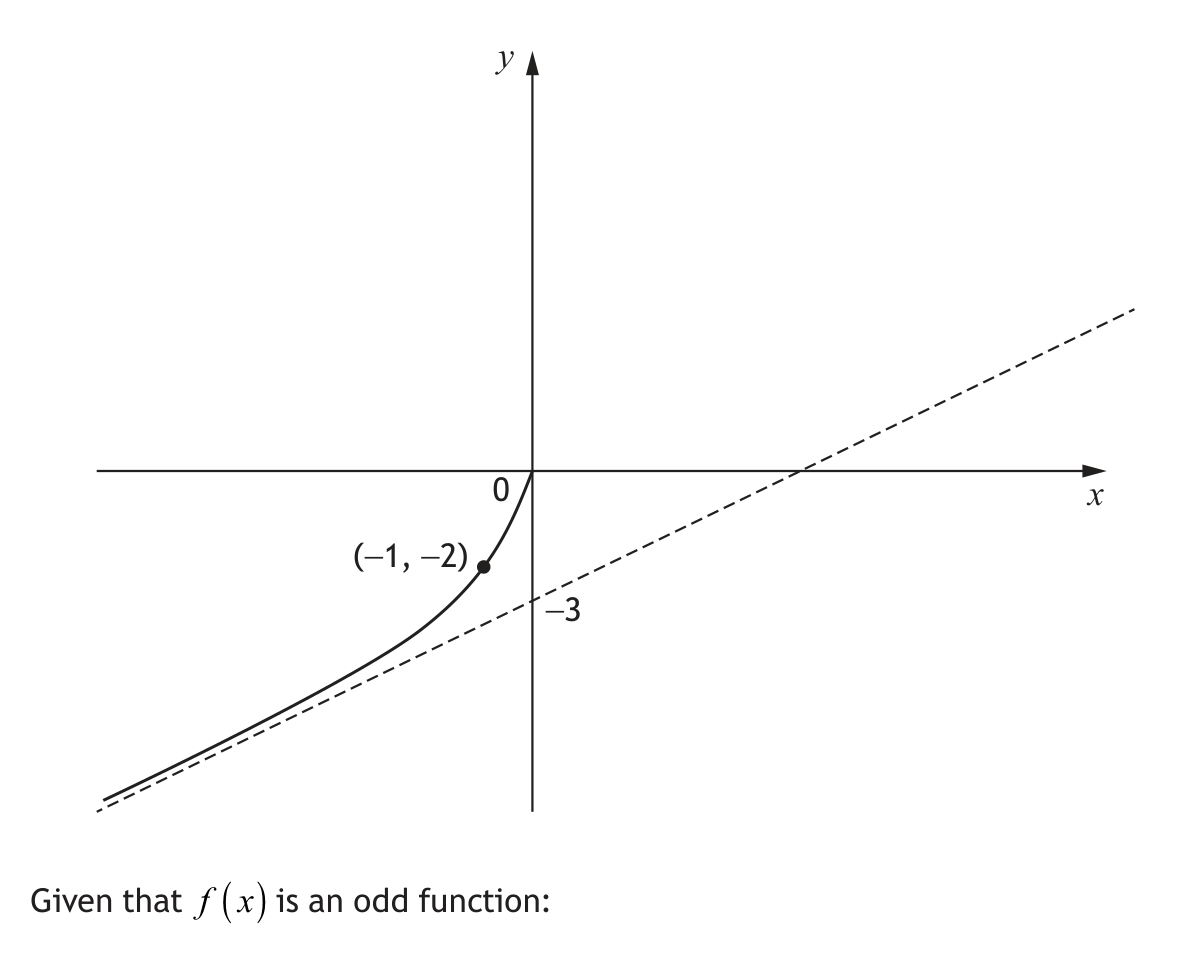
In the diagram below part of the graph of y=f(x)\displaystyle y=f(x) has been omitted. The point (1,2)\displaystyle (-1,-2) lies on the graph and the line y=12x3\displaystyle y=\frac{1}{2}x-3 is an asymptote.

Graph showing an asymptote and part of a curve with point (-1,-2)

Given that f(x)\displaystyle f(x) is an odd function:

(a)Copy and complete the diagram, including any asymptotes and any points you know to be on the graph.

(b)g(x)=f(x).\displaystyle g(x)=|f(x)|. On a separate diagram, sketch g(x).\displaystyle g(x).
Include known asymptotes and points.

(c)State the range of values of f(x)\displaystyle f'(x) given that f(0)=2.\displaystyle f'(0)=2.

Show answer
(a) Graph drawn with half-turn symmetry at the origin. New features include asymptote y=12x+3\displaystyle y = \frac{1}{2}x + 3 and point (1,2)\displaystyle (1, 2) clearly indicated.
(b) Graph showing the points (1,2)\displaystyle (-1, 2) and (1,2)\displaystyle (1, 2), with asymptotes meeting on the positive y-axis forming a V-shape.
(c) 12<f(x)2\displaystyle \frac{1}{2} < f'(x) \le 2
Show marking instructions

Question 12(a)

•¹ show half-turn symmetry and indicate (1,2)
Sketch showing odd function symmetry passing through (1,2)\displaystyle (1,2) and (1,2).\displaystyle (-1,-2).

•² demonstrate graph approaching parallel asymptote through (0,3)
Sketch showing asymptotic behaviour towards line passing through (0,3)\displaystyle (0,3) and (0,3).\displaystyle (0,-3).

Question 12(b)

•³ apply modulus function to graph obtained in (a)
Sketch showing reflection of negative y-values into positive y-values.

•⁴ illustrate asymptotes meeting on the y-axis
Sketch showing "V" shaped asymptotes meeting at (0,3).\displaystyle (0,3).

Question 12(c)

•⁵ state range
12<f(x)2\displaystyle \frac{1}{2} < f'(x) \le 2

13

Question 13

Methods of Proof
4 Marks
2017 Q13

Let n\displaystyle n be an integer.
Using proof by contrapositive, show that if n2\displaystyle n^2 is even, then n\displaystyle n is even.

Show answer
The contrapositive is: "If n\displaystyle n is odd, then n2\displaystyle n^2 is odd."
Let n=2k+1\displaystyle n = 2k + 1 for some integer k.\displaystyle k.
n2=(2k+1)2=4k2+4k+1=2(2k2+2k)+1.\displaystyle n^2 = (2k + 1)^2 = 4k^2 + 4k + 1 = 2(2k^2 + 2k) + 1.
Since 2k2+2k\displaystyle 2k^2 + 2k is an integer, n2\displaystyle n^2 is odd.
Since the contrapositive statement is true, the original statement is true.
Show marking instructions

Question 13

•¹ write down contrapositive statement
If n is odd then n2\displaystyle n^2 is odd.

•² write down appropriate form for n
n=2k+1\displaystyle n = 2k+1, kZ\displaystyle k \in \mathbb{Z}

•³ show n2\displaystyle n^2 is odd
n2=2(2k2+2k)+1\displaystyle n^2 = 2(2k^2+2k)+1 which is odd.

•⁴ communicate
Contrapositive statement is true therefore original statement is true.

14

Question 14

Differential Equations
10 Marks
2017 Q14

Find the particular solution of the differential equation

d2ydx26dydx+9y=8sinx+19cosx\displaystyle \frac{d^2y}{dx^2} - 6\frac{dy}{dx} + 9y = 8\sin x + 19\cos x

given that y=7\displaystyle y = 7 and dydx=12\displaystyle \frac{dy}{dx} = \frac{1}{2} when x=0.\displaystyle x = 0.

Show answer
y=5e3x14xe3x12sinx+2cosx\displaystyle y = 5e^{3x} - 14xe^{3x} - \frac{1}{2}\sin x + 2\cos x
Show marking instructions

Question 14

•¹ construct auxiliary equation
m26m+9=0\displaystyle m^2 - 6m + 9 = 0

•² solve auxiliary equation and state CF
y=Ae3x+Bxe3x\displaystyle y = Ae^{3x} + Bxe^{3x}

•³ state PI
y=Csinx+Dcosx\displaystyle y = C\sin x + D\cos x

•⁴ obtain first and second derivatives of PI
dydx=CcosxDsinx\displaystyle \frac{dy}{dx} = C\cos x - D\sin x and d2ydx2=CsinxDcosx\displaystyle \frac{d^2y}{dx^2} = -C\sin x - D\cos x

•⁵ substitute
CsinxDcosx6(CcosxDsinx)+9(Csinx+Dcosx)=8sinx+19cosx\displaystyle -C\sin x - D\cos x - 6(C\cos x - D\sin x) + 9(C\sin x + D\cos x) = 8\sin x + 19\cos x

•⁶ derive equations
8C+6D=8\displaystyle 8C + 6D = 8 and 6C+8D=19\displaystyle -6C + 8D = 19

•⁷ obtain both constants of PI
C=12\displaystyle C = -\frac{1}{2}, D=2\displaystyle D = 2

•⁸ differentiate general solution
dydx=3Ae3x+Be3x+3Bxe3x12cosx2sinx\displaystyle \frac{dy}{dx} = 3Ae^{3x} + Be^{3x} + 3Bxe^{3x} - \frac{1}{2}\cos x - 2\sin x

•⁹ determine first constant of general solution
A=5\displaystyle A = 5 or B=14\displaystyle B = -14

•¹⁰ determine second constant and state particular solution
y=5e3x14xe3x12sinx+2cosx\displaystyle y = 5e^{3x} - 14xe^{3x} - \frac{1}{2}\sin x + 2\cos x

15

Question 15

Vectors
(2, 4, 3)9 Marks
2017 Q15

(a)A beam of light passes through the points B(7,8,1)\displaystyle B(7,8,1) and T(3,22,6).\displaystyle T(-3,-22,6).
Obtain parametric equations of the line representing the beam of light.

(b)A sheet of metal is represented by a plane containing the points P(2,1,9)\displaystyle P(2,1,9), Q(1,2,7)\displaystyle Q(1,2,7) and R(3,7,1).\displaystyle R(-3,7,1).
Find the Cartesian equation of the plane.

(c)The beam of light passes through a hole in the metal at point H.\displaystyle H.
Find the coordinates of H.\displaystyle H.

Show answer
(a) x=2λ+7\displaystyle x = 2\lambda + 7, y=6λ+8\displaystyle y = 6\lambda + 8, z=λ+1\displaystyle z = -\lambda + 1 (or equivalent)
(b) 4x+2yz=1\displaystyle 4x + 2y - z = 1
(c) H(3,4,3)\displaystyle H(3, -4, 3)
Show marking instructions

Question 15(a)

•¹ obtain direction vector
d=(261)\displaystyle d = \begin{pmatrix} 2 \\ 6 \\ -1 \end{pmatrix} or multiple thereof.

•² state parametric equations
x=2λ+7\displaystyle x = 2\lambda + 7, y=6λ+8\displaystyle y = 6\lambda + 8, z=λ+1\displaystyle z = -\lambda + 1

Question 15(b)

•³ identify vectors
Any two from PQ=(112)\displaystyle \overrightarrow{PQ} = \begin{pmatrix} -1 \\ 1 \\ -2 \end{pmatrix}, PR=(568)\displaystyle \overrightarrow{PR} = \begin{pmatrix} -5 \\ 6 \\ -8 \end{pmatrix}, QR=(456)\displaystyle \overrightarrow{QR} = \begin{pmatrix} -4 \\ 5 \\ -6 \end{pmatrix}

•⁴ evidence of strategy for finding normal
PQ×PR=ijk112568\displaystyle \overrightarrow{PQ} \times \overrightarrow{PR} = \begin{vmatrix} \mathbf{i} & \mathbf{j} & \mathbf{k} \\ -1 & 1 & -2 \\ -5 & 6 & -8 \end{vmatrix}

•⁵ calculate normal
n=(421)\displaystyle n = \begin{pmatrix} 4 \\ 2 \\ -1 \end{pmatrix}

•⁶ obtain equation
4x+2yz=1\displaystyle 4x + 2y - z = 1

Question 15(c)

•⁷ substitute into equation of plane
4(2λ+7)+2(6λ+8)(λ+1)=1\displaystyle 4(2\lambda + 7) + 2(6\lambda + 8) - (-\lambda + 1) = 1

•⁸ find λ\displaystyle \lambda
λ=2\displaystyle \lambda = -2

•⁹ determine coordinates of H
H(3,4,3)\displaystyle H(3, -4, 3)

16

Question 16

Integration
5 Marks
2017 Q16

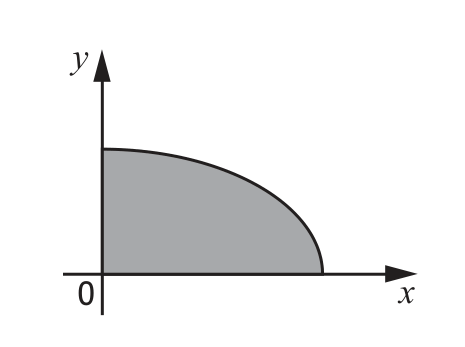
On a suitable domain, a curve is defined by the equation 4x2+9y2=36.\displaystyle 4x^2 + 9y^2 = 36. A section of the curve in the first quadrant, illustrated in the diagram below, is rotated 360\displaystyle 360^\circ about the y\displaystyle y-axis.

Curve of 4x^2 + 9y^2 = 36 rotated about y-axis

Calculate the exact value of the volume generated.

Show answer
12π\displaystyle 12\pi
Show marking instructions

Question 16

•¹ state form of integral
V=πx2dy\displaystyle V = \pi\int x^2 dy or V=π(f(y))2dy\displaystyle V = \pi\int (f(y))^2 dy

•² rearrange and substitute for x2\displaystyle x^2
V=π(994y2)dy\displaystyle V = \pi\int (9 - \frac{9}{4}y^2) dy

•³ calculate limits to match variable
y=0\displaystyle y = 0, y=2\displaystyle y = 2

•⁴ integrate
V=π[9y3y34]02\displaystyle V = \pi[9y - \frac{3y^3}{4}]_0^2

•⁵ evaluate
V=12π\displaystyle V = 12\pi

17

Question 17

Complex Numbers
(1, 6, 1)8 Marks
2017 Q17

The complex number z=2+i\displaystyle z = 2+i is a root of the polynomial equation z46z3+16z222z+q=0\displaystyle z^4 - 6z^3 + 16z^2 - 22z + q = 0, where qZ.\displaystyle q \in \mathbb{Z}.

(a)State a second root of the equation.

(b)Find the value of q\displaystyle q and the remaining roots.

(c)Show the solutions to z46z3+16z222z+q=0\displaystyle z^4 - 6z^3 + 16z^2 - 22z + q = 0 on an Argand diagram.

Show answer
(a) 2i\displaystyle 2 - i
(b) q=15\displaystyle q = 15
Remaining roots are 1+2i\displaystyle 1 + \sqrt{2}i and 12i.\displaystyle 1 - \sqrt{2}i.
(c) An Argand diagram showing the points (2,1)\displaystyle (2, 1), (2,1)\displaystyle (2, -1), (1,2)\displaystyle (1, \sqrt{2}), and (1,2)\displaystyle (1, -\sqrt{2}) plotted correctly relative to each other.
Show marking instructions

Question 17(a)

•¹ state second root
2i\displaystyle 2 - i

Question 17(b)

•² obtain two linear factors
z(2+i)\displaystyle z - (2+i), z(2i)\displaystyle z - (2-i)

•³ obtain quadratic factor
z24z+5\displaystyle z^2 - 4z + 5

•⁴ set up algebraic division or equivalent
z46z3+16z222z+q÷(z24z+5)\displaystyle z^4 - 6z^3 + 16z^2 - 22z + q \div (z^2 - 4z + 5) leading to quotient z22z+3\displaystyle z^2 - 2z + 3

•⁵ complete algebraic division/state value of q
q=15\displaystyle q = 15

•⁶ obtain remaining two roots
1±2i\displaystyle 1 \pm \sqrt{2}i

Question 17(c)

•⁷ show all four solutions on an Argand diagram
Plot (2,1)\displaystyle (2,1), (2,1)\displaystyle (2,-1), (1,2)\displaystyle (1, \sqrt{2}), and (1,2)\displaystyle (1, -\sqrt{2}) in correct relative positions.

18

Question 18

Differentiation
(5, 2)7 Marks
2017 Q18

The position of a particle at time t\displaystyle t is given by the parametric equations x=tcost\displaystyle x=t\cos t, y=tsint\displaystyle y=t\sin t (t0\displaystyle t \ge 0).

(a)Find an expression for the instantaneous speed of the particle.

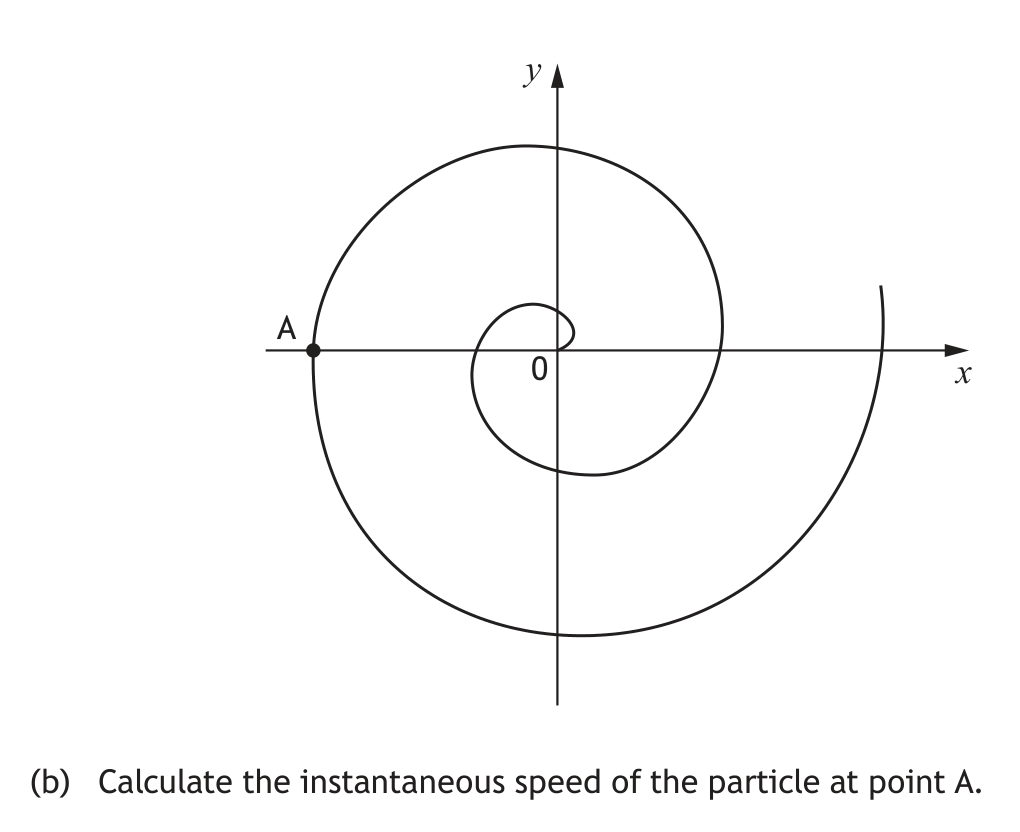
The diagram below shows the path that the particle takes.

Spiral path of a particle with point A marked

(b)Calculate the instantaneous speed of the particle at point A.

Show answer
(a) 1+t2\displaystyle \sqrt{1 + t^2}
(b) 1+9π2\displaystyle \sqrt{1 + 9\pi^2}
Show marking instructions

Question 18(a)

•¹ evidence of use of product rule to find either dxdt\displaystyle \frac{dx}{dt} or dydt\displaystyle \frac{dy}{dt} with one term correct
eg dxdt=cost+\displaystyle \frac{dx}{dt} = \cos t + \dots

•² obtain dxdt\displaystyle \frac{dx}{dt} or dydt\displaystyle \frac{dy}{dt}
dxdt=costtsint\displaystyle \frac{dx}{dt} = \cos t - t\sin t

•³ obtain remaining derivative
dydt=sint+tcost\displaystyle \frac{dy}{dt} = \sin t + t\cos t

•⁴ state formula for instantaneous speed
speed=(dxdt)2+(dydt)2\displaystyle \text{speed} = \sqrt{(\frac{dx}{dt})^2 + (\frac{dy}{dt})^2} stated or implied.

•⁵ obtain expression
(costtsint)2+(sint+tcost)2=1+t2\displaystyle \sqrt{(\cos t - t\sin t)^2 + (\sin t + t\cos t)^2} = \sqrt{1+t^2}

Question 18(b)

•⁶ evidence of valid strategy to find value of t and obtain at least one non-zero solution
0=tsint\displaystyle 0 = t\sin t and eg t=π\displaystyle t = \pi

•⁷ choose correct value for t and calculate speed
t=3π\displaystyle t = 3\pi, speed=1+9π2\displaystyle \text{speed} = \sqrt{1+9\pi^2}