1
Question 1
Differentiation2 Marks
2021 P2 Q1
Given find the exact value of
Show answerHide answer
Show marking instructionsHide marking instructions
Question 1
•¹ differentiate
•² evaluate
Advanced Higher Maths · SQA past paper
Given find the exact value of
•¹ differentiate
•² evaluate
(a)Use the Euclidean algorithm to find integers and such that
(b)Hence find integers and such that
•¹ complete algorithm
•² equates gcd and evidence of substitution
•³ a and b obtained
,
•⁴ find x and y
,
Use integration by parts to find
•¹ use integration by parts and start process
•² complete application
•³ complete integration
A curve is defined parametrically by and
(a)Find and
(b)When find the equation of the tangent to the curve.
•¹ start to find dx/dt
•² complete dx/dt
•³ state dy/dt
•⁴ begin process
OR
•⁵ find the equation of the tangent
A non-singular matrix satisfies the equation , where is the identity matrix.
(a)Express in the form , where
(b)Express in the form , where
•¹ find expression for A⁴ in powers of two and less
OR
•² substitute for A² and simplify
•³ evidence of strategy
e.g. OR
•⁴ state expression
Solve the differential equation
given that when , Express in terms of
•¹ find integrating factor
•² write in correct form
•³ integrate right hand side including constant of integration
•⁴ find particular solution
A complex number is defined by where is a positive real number.
(a)State and simplify the binomial expansion of
(b)Given that where is a real number, find the values of and
•¹ binomial expansion
•² binomial coefficients and powers of 2
Stated or implied by
•³ simplify
•⁴ substitute
•⁵ equate imaginary and real parts
and
•⁶ find a and b
,
A curve is defined by
(a)Find in terms of and
(b)Show that there is only one stationary point on the curve.
•¹ start to differentiate product with one term correct
or
•² complete differentiation of product
or
•³ differentiate remaining terms
•⁴ write derivative explicitly in terms of x and y
•⁵ express condition for stationary point
•⁶ state corresponding values of both x and y
AND
•⁷ show that there is one value of y when x = 0 but no value of x when y = 0
AND e.g. ... no solution
(a)Express in partial fractions.
A small island is being populated by seals. The size of the seal population can be modelled by the differential equation
where (in hundreds) is the number of seals on the island years after the seals arrive.
(b)Given that there are 250 seals after 10 years, find an expression for in terms of
•¹ write template
•² find constants and express in partial fractions
•³ write as integral equation
•⁴ write LHS integral in partial fractions
•⁵ complete integration
•⁶ substitute values
•⁷ constant of integration
•⁸ evaluate
•⁹ take exponentials
•¹⁰ write expression in terms of t
Prove by induction that
for all positive integers
•¹ show true for n = 2
LHS:
RHS:
so true for
•² assume (statement) true for n = k AND consider whether (statement) true for n = k + 1
suitable statement and AND
•³ correct statement for sum to (k + 1) terms using inductive hypothesis
•⁴ express as a single fraction
•⁵ express explicitly in terms of (k + 1) AND communicate
leading to
If true for then true for Also shown true for therefore, by induction, true for all
Three consecutive terms of an arithmetic sequence are given by
(a)(i) Find the common difference.
(ii) Hence find the value of
(b)Given that is the term, find
(i) the value of the first term
(ii) a simplified expression for the term of the sequence.
Three consecutive terms of a geometric sequence are given by
(c)Find the two possible values of and the corresponding common ratios.
One of the values of gives an associated geometric series which has a sum to infinity.
(d)(i) Identify the value of and justify your answer.
(ii) Determine whether is a possible value for this sum to infinity. Give a reason for your answer.
The points , and all lie on the plane
(a)Find the Cartesian equation of
The plane is parallel to and passes through the origin.
(b)State the equation of
A sphere touches , where is the point of contact. The sphere also has a single point of contact, , with
(c)(i) Find parametric equations for the line
(ii) Hence find the coordinates for
•¹ find two directed line segments
,
•² begin to find vector product
e.g.
•³ calculate a normal vector
e.g.
•⁴ obtain equation
•⁵ state equation of π₂
•⁶ find parametric equations
•⁷ substitute into equation of π₂
•⁸ find coordinates of Q
(a)Express in the form
The complex number is defined by
(b)Use de Moivre's theorem to show that is a root of the equation
The complex number is also a root of the equation Roots and have been plotted on an Argand diagram, as shown.
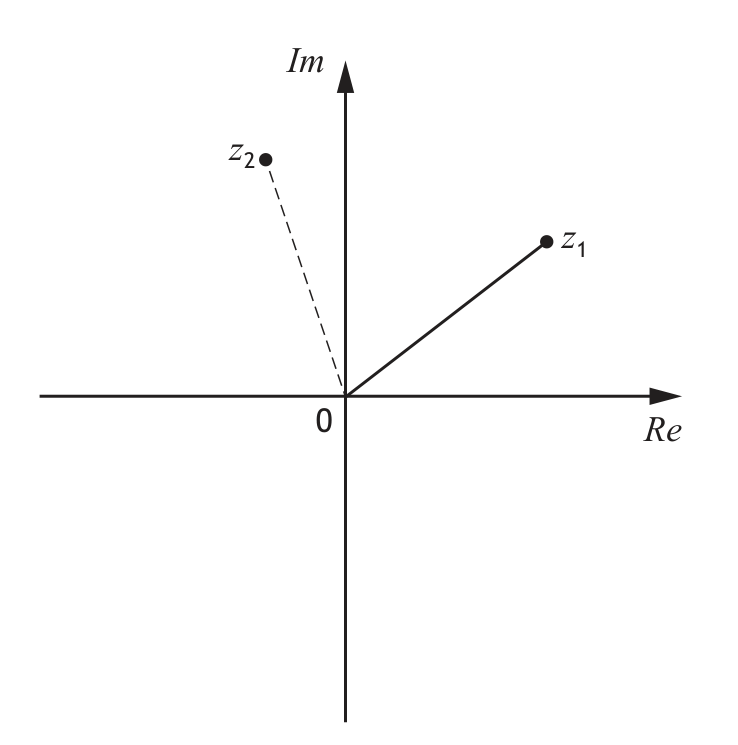
(c)Express in the form
The remaining roots of the equation are , and
(d)Express , and in the form , where
(e) Given , show algebraically that
•¹ express in appropriate form
•² verify root
•³ polar form
•⁴,⁵ remaining roots
or
•⁶ equate real part to zero
leading to
•⁷ complete proof