Advanced Higher Maths · SQA past paper

2022 Paper 1

Non-Calculator · 8 questions
1(a)

Question 1(a)

Differentiation
3 Marks
2022 P1 Q1(a)

Given y=13xx2+4\displaystyle y = \frac{1-3x}{x^2+4}, find dydx.\displaystyle \frac{dy}{dx}. Simplify your answer.

Show answer
3x22x12(x2+4)2\displaystyle \frac{3x^2 - 2x - 12}{(x^2+4)^2}
1(b)

Question 1(b)

Differentiation
2 Marks
2022 P1 Q1(b)

Given f(x)=cosec 5x\displaystyle f(x) = \text{cosec } 5x, find f(x).\displaystyle f'(x).

Show answer
5cosec 5xcot5x\displaystyle -5\text{cosec } 5x \cot 5x
2

Question 2

Systems of Equations
4 Marks
2022 P1 Q2

Use Gaussian elimination to solve the following system of equations:

x2y+z=4\displaystyle x - 2y + z = 4
2x+y3z=3\displaystyle 2x + y - 3z = 3
x7y4z=9\displaystyle x - 7y - 4z = 9

Show answer
x=2,y=1,z=0\displaystyle x = 2, y = -1, z = 0
3

Question 3

Complex Numbers
2 Marks
2022 P1 Q3

Given that z1=5+3i\displaystyle z_1 = 5 + 3i and z2=6+2i\displaystyle z_2 = 6 + 2i, express z1z2\displaystyle z_1\overline{z_2} in the form a+ib\displaystyle a + ib where a\displaystyle a and b\displaystyle b are real numbers.

Show answer
36+8i\displaystyle 36 + 8i
4

Question 4

Differentiation
(3, 1, 2)6 Marks
2022 P1 Q4

A curve is defined by the equation y3+4y=2xy+1.\displaystyle y^3 + 4y = 2xy + 1.

(a)Use implicit differentiation to find an expression for dydx.\displaystyle \frac{dy}{dx}.

(b)Find the gradient of the tangent to the curve when y=1.\displaystyle y = -1.

(c)Show that the curve has no stationary point.

Show answer
(a) 2y3y2+42x\displaystyle \frac{2y}{3y^2 + 4 - 2x}
(b) 2\displaystyle -2
(c) Setting dydx=0\displaystyle \frac{dy}{dx} = 0 yields 2y=0y=0.\displaystyle 2y = 0 \Rightarrow y = 0. Substituting y=0\displaystyle y = 0 into the original equation gives 0=1\displaystyle 0 = 1, which is inconsistent. Therefore, there are no stationary points.
5

Question 5

Maclaurin Series
(2, 2)4 Marks
2022 P1 Q5

(a)Find, and simplify, the Maclaurin expansion for e4x\displaystyle e^{-4x} up to and including the term in x3.\displaystyle x^3.

(b)Hence find the first four terms of the Maclaurin expansion of 3+2xe4x.\displaystyle \frac{3+2x}{e^{4x}}.

Show answer
(a) 14x+8x2323x3\displaystyle 1 - 4x + 8x^2 - \frac{32}{3}x^3
(b) 310x+16x216x3\displaystyle 3 - 10x + 16x^2 - 16x^3
6

Question 6

Methods of Proof
(1, 3)4 Marks
2022 P1 Q6

Consider the statement: For all odd numbers n\displaystyle n, n2+4\displaystyle n^2 + 4 is prime.

(a)Find a counterexample to show that the statement is false.

(b)Prove directly that the difference between the cubes of any two consecutive integers is not divisible by 3.

Show answer
(a) e.g. when n=9\displaystyle n = 9, n2+4=85\displaystyle n^2 + 4 = 85, which is divisible by 5 and therefore not prime.
(b) Let the consecutive integers be n\displaystyle n and n+1.\displaystyle n+1. Then (n+1)3n3=3(n2+n)+1\displaystyle (n+1)^3 - n^3 = 3(n^2 + n) + 1, which leaves a remainder of 1 when divided by 3, so it is not divisible by 3.
7

Question 7

Integration
(4, 1, 1, 4)10 Marks
2022 P1 Q7

(a)Use the substitution u=y2+1\displaystyle u = y^2 + 1, or otherwise, to find the exact value of

054yy2+1dy.\displaystyle \int_0^5 \frac{4y}{\sqrt{y^2+1}} \,dy.

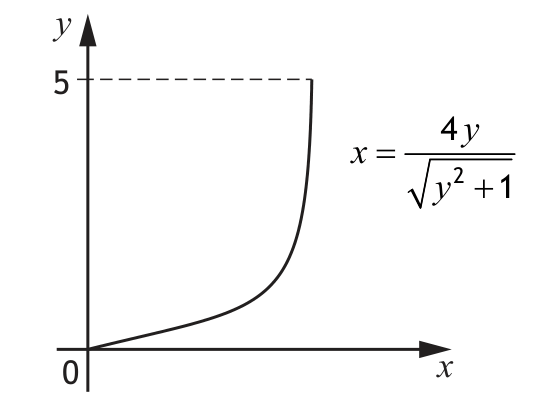
Student engineers are using a 3D printer to make a model. Relative to a suitable set of axes, the cross-section of the model is symmetrical about the y\displaystyle y-axis and is represented in the first quadrant by the curve x=4yy2+1\displaystyle x = \frac{4y}{\sqrt{y^2+1}}, 0y5.\displaystyle 0 \le y \le 5.

Curve of x = 4y / sqrt(y^2 + 1) bounding an area to the y-axis

(b)State the area of the cross-section.

(c)Express y2y2+1\displaystyle \frac{y^2}{y^2+1} in the form a+by2+1\displaystyle a + \frac{b}{y^2+1} where a\displaystyle a and b\displaystyle b are real numbers.

The curve x=4yy2+1\displaystyle x = \frac{4y}{\sqrt{y^2+1}}, 0y5\displaystyle 0 \le y \le 5 will be rotated through 2π\displaystyle 2\pi radians about the y\displaystyle y-axis to make the model.

(d)Find the volume of the model.

Show answer
(a) 4(261)\displaystyle 4(\sqrt{26} - 1)
(b) 8(261)\displaystyle 8(\sqrt{26} - 1) (square units)
(c) 11y2+1\displaystyle 1 - \frac{1}{y^2+1}
(d) 16π(5tan15)\displaystyle 16\pi(5 - \tan^{-1} 5) (cubic units)