Advanced Higher Maths · SQA past paper

2022 Paper 2

Calculator · 13 questions
Generate a practice paper like this one

Question 1

Partial fractions
3 Marks
2022 P2 Q1

Express 3x2−3x+5x(x2+5)\displaystyle \frac{3x^{2}-3x+5}{x(x^{2}+5)} in partial fractions.

Show answer
1x+2x−3x2+5\displaystyle \frac{1}{x} + \frac{2x-3}{x^{2}+5}

Question 2

Integrating rational functions
2 Marks
2022 P2 Q2

Find the exact value of ∫0342x+1dx.\displaystyle \int_{0}^{3}\frac{4}{2x+1}dx.

Show answer
2ln⁡7\displaystyle 2 \ln 7

Question 3

Euclidean algorithm
3 Marks
2022 P2 Q3

Use the Euclidean algorithm to find integers a\displaystyle a and b\displaystyle b such that 634a+87b=1.\displaystyle 634a+87b=1.

Show answer
a=7\displaystyle a = 7, b=−51\displaystyle b = -51

Question 4

Integration by parts
3 Marks
2022 P2 Q4

Use integration by parts to find ∫(x+2)(2x+7)12dx.\displaystyle \int(x+2)(2x+7)^{\frac{1}{2}}dx.

Show answer
13(x+2)(2x+7)32−115(2x+7)52+c\displaystyle \frac{1}{3}(x+2)(2x+7)^{\frac{3}{2}} - \frac{1}{15}(2x+7)^{\frac{5}{2}} + c

Question 5

Determinant and inverse
3 Marks
2022 P2 Q5

Matrix A\displaystyle A is given by A=(1312k3k18−7)\displaystyle A=\begin{pmatrix}1&3&1\\2&k&3\\k&18&-7\end{pmatrix}, where k∈R.\displaystyle k\in\mathbb{R}.
Find the values of k\displaystyle k so that the matrix A\displaystyle A is singular.

Show answer
6\displaystyle 6 and −4\displaystyle -4

Question 6

Arithmetic sequences and series
(2, 2, 2)6 Marks
2022 P2 Q6

The first three terms of a sequence are defined algebraically by x+5\displaystyle x+5, 3x+2\displaystyle 3x+2, 5x−1\displaystyle 5x-1, where x∈N.\displaystyle x\in\mathbb{N}.

(a)Show that these three terms form the start of an arithmetic sequence.

(b)Find a simplified expression for the 15th\displaystyle 15^{th} term of this sequence.

(c)Given that the sum of the first 20 terms of this sequence is 1130, find the value of x.\displaystyle x.

Show answer
(a) (3x+2)−(x+5)=2x−3\displaystyle (3x+2) - (x+5) = 2x-3 and (5x−1)−(3x+2)=2x−3.\displaystyle (5x-1) - (3x+2) = 2x-3. Common difference is the same, so it is arithmetic.
(b) 29x−37\displaystyle 29x - 37
(c) x=4\displaystyle x = 4

Question 7

Equations with complex roots
(1, 2, 1)4 Marks
2022 P2 Q7

The complex number z=3+i\displaystyle z=3+i is a root of z2−6z+a=0\displaystyle z^{2}-6z+a=0 where a\displaystyle a is a real number.

(a)State the second root of z2−6z+a=0.\displaystyle z^{2}-6z+a=0.

(b)Hence, or otherwise, find the value of a.\displaystyle a.

The expression z2−6z+a\displaystyle z^{2}-6z+a is a factor of z3−z2−20z+b\displaystyle z^{3}-z^{2}-20z+b where b\displaystyle b is a real number.

(c)Find the value of b.\displaystyle b.

Show answer
(a) 3−i\displaystyle 3 - i
(b) 10\displaystyle 10
(c) 50\displaystyle 50

Question 8

Product, quotient, chain rulesFirst order linear DE
(2, 4)6 Marks
2022 P2 Q8

(a)Differentiate xln⁡x−x\displaystyle x \ln x - x with respect to x.\displaystyle x.

(b)Hence find the general solution of the differential equation dydx+yln⁡x=x−x.\displaystyle \frac{dy}{dx} + y \ln x = x^{-x}.

Show answer
(a) ln⁡x\displaystyle \ln x
(b) y=−e−x+cxxe−x\displaystyle y = \frac{-e^{-x} + c}{x^{x}e^{-x}}

Question 9

Proof by inductionMatrix operations
5 Marks
2022 P2 Q9

The matrix A\displaystyle A is given by A=(3−201).\displaystyle A=\begin{pmatrix}3&-2\\0&1\end{pmatrix}.
Prove by induction that An=(3n1−3n01),∀n∈N.\displaystyle A^{n}=\begin{pmatrix}3^{n}&1-3^{n}\\0&1\end{pmatrix}, \forall n\in \mathbb{N}.

Show answer
When n=1\displaystyle n=1, (311−3101)=(3−201)=A\displaystyle \begin{pmatrix}3^{1}&1-3^{1}\\0&1\end{pmatrix}=\begin{pmatrix}3&-2\\0&1\end{pmatrix}=A, so the statement is true.
Assume true for n=k\displaystyle n=k: Ak=(3k1−3k01).\displaystyle A^{k}=\begin{pmatrix}3^{k}&1-3^{k}\\0&1\end{pmatrix}.
Then Ak+1=A Ak=(3−201)(3k1−3k01)=(3×3k3(1−3k)−201)=(3k+11−3k+101).\displaystyle A^{k+1}=A\,A^{k}=\begin{pmatrix}3&-2\\0&1\end{pmatrix}\begin{pmatrix}3^{k}&1-3^{k}\\0&1\end{pmatrix}=\begin{pmatrix}3\times3^{k}&3(1-3^{k})-2\\0&1\end{pmatrix}=\begin{pmatrix}3^{k+1}&1-3^{k+1}\\0&1\end{pmatrix}.
True for n=1\displaystyle n=1, and true for n=k\displaystyle n=k implies true for n=k+1\displaystyle n=k+1, so by induction the statement holds ∀n∈N.\displaystyle \forall n\in\mathbb{N}.

Question 10

Second order non-homogeneous DE
9 Marks
2022 P2 Q10

Solve the differential equation d2ydx2−4dydx+4y=9sin⁡x+13cos⁡x\displaystyle \frac{d^{2}y}{dx^{2}}-4\frac{dy}{dx}+4y=9 \sin x+13 \cos x given that y=5\displaystyle y=5 and dydx=0\displaystyle \frac{dy}{dx}=0 when x=0.\displaystyle x=0.

Show answer
y=2e2x−3xe2x−sin⁡x+3cos⁡x\displaystyle y = 2e^{2x} - 3xe^{2x} - \sin x + 3\cos x

Question 11

Related rates of change
4 Marks
2022 P2 Q11

A curve defined parametrically has the following properties:
x=tan⁡−12t\displaystyle x = \tan^{-1} 2t
dydx=6t(1+4t2)\displaystyle \frac{dy}{dx} = 6t(1+4t^{2})
y=5\displaystyle y = 5 when t=1.\displaystyle t = 1.
Find y\displaystyle y in terms of t.\displaystyle t.

Show answer
y=6t2−1\displaystyle y = 6t^{2} - 1

Question 12

de Moivre's theoremBinomial expansion
(1, 3, 2, 2)8 Marks
2022 P2 Q12

Let z=cos⁡θ+isin⁡θ.\displaystyle z = \cos \theta + i \sin \theta.

(a)Use de Moivre's theorem to state an expression for z4.\displaystyle z^{4}.

(b)State and simplify the binomial expansion of (cos⁡θ+isin⁡θ)4.\displaystyle (\cos \theta + i \sin \theta)^{4}.

(c)Hence show that:
(i) cos⁡4θ=8cos⁡4θ−8cos⁡2θ+1.\displaystyle \cos 4\theta = 8\cos^{4}\theta - 8\cos^{2}\theta + 1.
(ii) sin⁡θcot⁡4θ\displaystyle \sin \theta \cot 4\theta can be written in terms of cos⁡θ\displaystyle \cos \theta only.

Show answer
(a) cos⁡4θ+isin⁡4θ\displaystyle \cos 4\theta + i \sin 4\theta
(b) cos⁡4θ+4icos⁡3θsin⁡θ−6cos⁡2θsin⁡2θ−4icos⁡θsin⁡3θ+sin⁡4θ\displaystyle \cos^{4}\theta + 4i \cos^{3}\theta \sin \theta - 6\cos^{2}\theta \sin^{2}\theta - 4i \cos \theta \sin^{3}\theta + \sin^{4}\theta
(c)(i) Equating real parts: cos⁡4θ=cos⁡4θ−6cos⁡2θsin⁡2θ+sin⁡4θ=8cos⁡4θ−8cos⁡2θ+1\displaystyle \cos 4\theta = \cos^{4}\theta - 6\cos^{2}\theta \sin^{2}\theta + \sin^{4}\theta = 8\cos^{4}\theta - 8\cos^{2}\theta + 1
(c)(ii) 8cos⁡4θ−8cos⁡2θ+18cos⁡3θ−4cos⁡θ\displaystyle \frac{8\cos^{4}\theta - 8\cos^{2}\theta + 1}{8\cos^{3}\theta - 4\cos \theta}

Question 13

Related rates of changeRectilinear motion
(1, 4, 1, 3)9 Marks
2022 P2 Q13

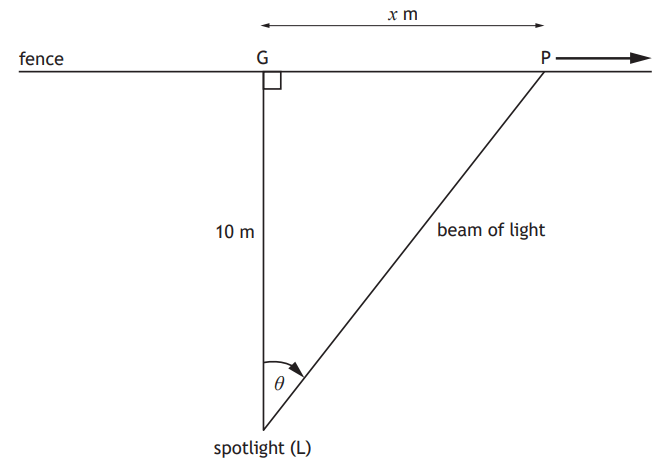
A security spotlight is situated 10 metres from a straight fence. The spotlight rotates at a constant speed and makes one full revolution every 12 seconds. L\displaystyle L is the spotlight, G\displaystyle G is the nearest point on the fence, P\displaystyle P is where the light hits the fence, θ\displaystyle \theta is the angle between LG\displaystyle LG and LP\displaystyle LP, and x\displaystyle x is the distance in metres from G\displaystyle G to P.\displaystyle P.

Spotlight pointing at a fence

(a)Show that:
(i) dθdt=π6\displaystyle \frac{d\theta}{dt} = \frac{\pi}{6} radians per second
(ii) dxdt=5π3sec⁡2θ\displaystyle \frac{dx}{dt} = \frac{5\pi}{3}\sec^{2}\theta metres per second.

(b)Prove that 1+tan⁡2θ=sec⁡2θ.\displaystyle 1+\tan^{2}\theta=\sec^{2}\theta.

(c)Hence, or otherwise, find the exact value of dxdt\displaystyle \frac{dx}{dt} when P\displaystyle P is 5 metres from G.\displaystyle G.

Show answer
(a)(i) 2π12=π6\displaystyle \frac{2\pi}{12} = \frac{\pi}{6}
(a)(ii) x=10tan⁡θ\displaystyle x = 10 \tan \theta, so dxdt=10sec⁡2θ⋅π6=5π3sec⁡2θ\displaystyle \frac{dx}{dt} = 10\sec^{2}\theta \cdot \frac{\pi}{6} = \frac{5\pi}{3}\sec^{2}\theta
(b) 1+sin⁡2θcos⁡2θ=1cos⁡2θ=sec⁡2θ\displaystyle 1 + \frac{\sin^{2}\theta}{\cos^{2}\theta} = \frac{1}{\cos^{2}\theta} = \sec^{2}\theta
(c) 25π12 ms−1\displaystyle \frac{25\pi}{12} \text{ ms}^{-1}