1
Question 1
Differentiation2 Marks
2025 P2 Q1
A function is defined by
Find
Show answerHide answer
(or )
Advanced Higher Maths · SQA past paper
A function is defined by
Find
A curve is defined by the equation
Find an expression for in terms of and
Express in partial fractions.
(a)Use the Euclidean algorithm to find , the greatest common divisor of 1118 and 416.
(b)Hence find integers and such that
A curve is defined by
Use logarithmic differentiation to find
Write your answer in terms of
(a)Find and simplify the Maclaurin expansion, up to and including the term in , for
(b)Hence find and simplify the Maclaurin expansion, up to and including the term in , for
A curve is defined on a suitable domain by the equations and
Find in terms of :
(a)
(b)
The matrix has the following property:
, where is the identity matrix.
(a)Express in the form , where
Matrix is non-singular.
(b)Find a similar expression for in terms of and
Relative to a fixed origin, the velocity, metres per second, of an object at time seconds is given by
(a)Find an expression for the displacement of the object, metres, in terms of , given that when
(b)Show that the acceleration of the object is always positive.
Find and fully factorise an expression for
(a)Using the substitution , or otherwise, find
The diagram shows part of the curve with equation
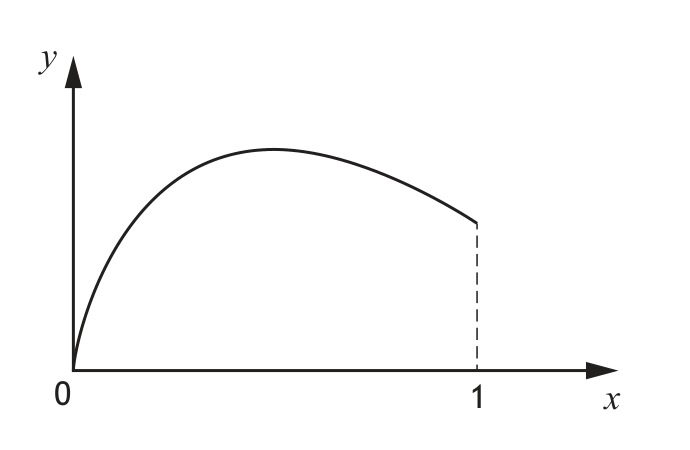
A solid is generated by rotating the curve through radians about the -axis from to
(b)Calculate the exact value of the volume generated.
Solve the differential equation
given that and when
An infinite geometric sequence of positive numbers has second term 100 and fourth term 16.
(a)Determine:
(i) the common ratio
(ii) the first term of this sequence.
(b)Explain why the associated geometric series has a sum to infinity.
(c)Determine this sum to infinity.
A new geometric sequence is formed by multiplying each term in the sequence above by the real number , where
(d)State the effect that this will have on:
(i) the common ratio
(ii) the sum to infinity of the associated series.
Find the general solution of the differential equation
Give your answer in the form
Prove by induction that, for all positive integers ,
Use integration by parts to find
The volume, cm, of water in a tank is given by
, where cm is the depth of water in the tank.
Water is being piped into the tank at a rate of 6 cm/second.
Water is leaking from the bottom of the tank at a rate of cm/second.
Calculate the rate of change of the depth of water when
Let be a complex number, where
(a)(i) Express in Cartesian form, where is the complex conjugate of
(ii) Given , find the argument of
When , where is the modulus of
(b)Use de Moivre's theorem to find, in polar form, both square roots of