Mathematical Modelling · Guided Practice
Units of Measure
7 questions with answers and video solutions. Try each one before revealing the answer.
is measured in kilograms (kg) and is measured in cubic metres (m).
Deduce the units of measure for .
Answer
is measured in newtons (N) and is measured in metres (m).
Deduce the units of measure for .
Answer
is measured in litres per hour and is measured in hours.
Deduce the units of measure for .
Answer
The hours cancel: litres per hour hours litres.
litres flow into the container in seconds.
Calculate the rate at which the container fills.
Your answer must include appropriate units.
Answer
litres per second.
Van B uses litres of fuel on its delivery route.
A manager concludes that Van A has the more efficient engine.
Explain why this conclusion is not valid.
Answer
Fuel efficiency must be compared as fuel used per unit of distance, for example litres per 100 km, not by total fuel used.
A builder estimates that a square patio of side metres will take hours, because the length has doubled.
Explain why this estimate is wrong, and calculate a better estimate.
Answer
Area of the first patio m; area of the second m, which is times as large.
A better estimate is hours.
A factory fills cans with a carbonated fruit drink. The cans produced have a volume of 330 millilitres.
The graph below shows the relationship between time, in seconds, and volume of carbonated fruit drink, in millilitres, as a can is filled.
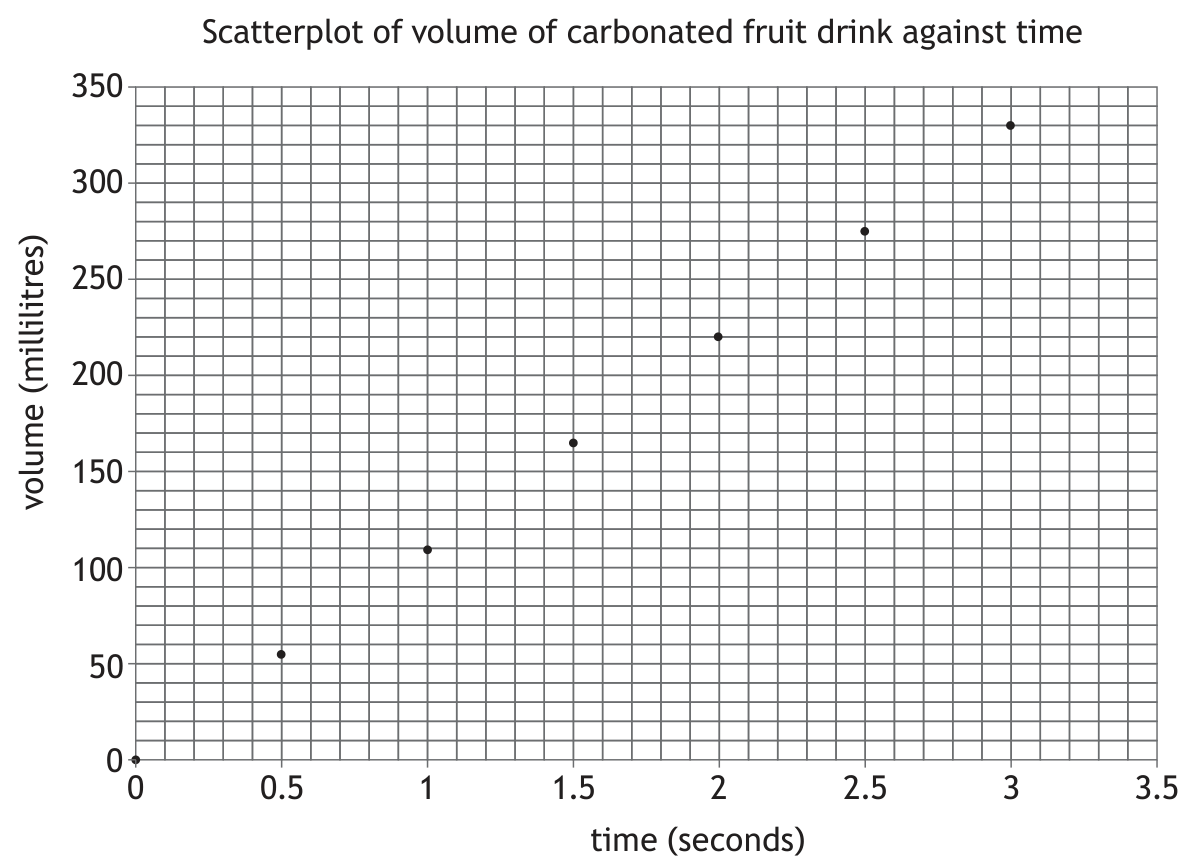
(a) State the type of relationship modelled in the graph.
(b) Determine the rate at which each can is filled with carbonated fruit drink. Your answer must include appropriate units.
The factory can only fill the cans when there are staff present. The machines in the factory can fill 5 cans at the same time.
(c) Estimate how many cans the factory can fill in one week. State any assumptions you have made.
Answer
(a) (Positive) linear.
(b) 110 millilitres per second.
(c) Assumption example: between 7 and 24 hours a day for 5-7 days. Calculation example (assuming 24 hours for 7 days): 100 cans per minute × 60 × 24 × 7 = 1,008,000 cans.