Higher Maths · SQA past paper

2015 Paper 2

Calculator · 9 questions
1

Question 1

Altitudes, medians, perpendicular bisectorsIntersection of straight lines
(4, 3, 2)9 Marks
2015 P2 Q1

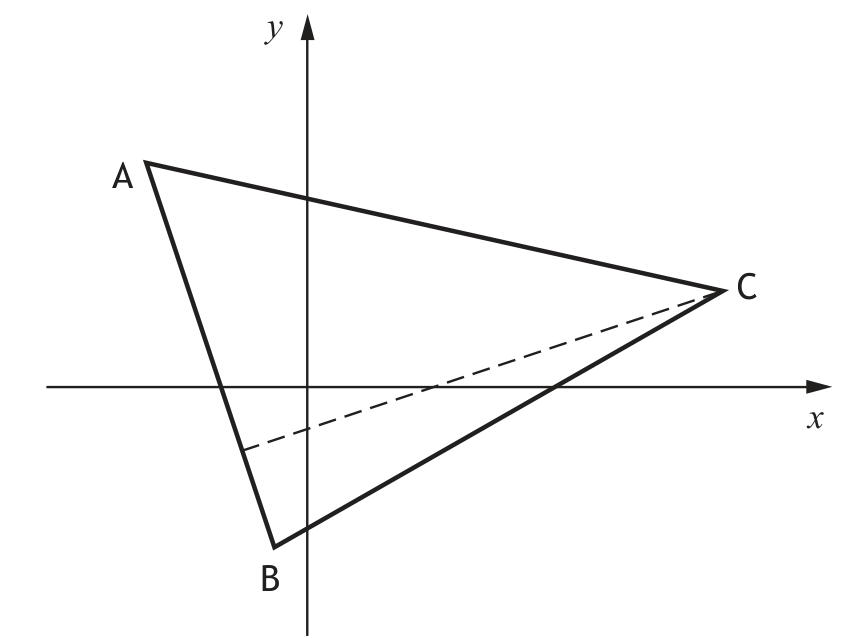
The vertices of triangle ABC are A(5,7)\displaystyle A(-5,7), B(1,5)\displaystyle B(-1,-5) and C(13,3)\displaystyle C(13,3) as shown in the diagram.
The broken line represents the altitude from C.

Triangle ABC

(a)  Show that the equation of the altitude from C is x3y=4.\displaystyle x-3y=4.
(b)  Find the equation of the median from B.
(c)  Find the coordinates of the point of intersection of the altitude from C and the median from B.

Show answer
(a) Proof
(b) y=2x3\displaystyle y=2x-3
(c) (1,1)\displaystyle (1, -1)
2

Question 2

Composite functionsCompleting the square
(2, 3, 2)7 Marks
2015 P2 Q2

Functions f\displaystyle f and g\displaystyle g are defined on suitable domains by
f(x)=10+x\displaystyle f(x)=10+x
and
g(x)=(1+x)(3x)+2\displaystyle g(x)=(1+x)(3-x)+2

(a)  Find an expression for f(g(x))\displaystyle f(g(x))
(b)  Express f(g(x))\displaystyle f(g(x)) in the form p(x+q)2+r\displaystyle p(x+q)^{2}+r
(c)  Another function h\displaystyle h is given by
h(x)=1f(g(x))\displaystyle h(x)=\frac{1}{f(g(x))}
What values of x\displaystyle x cannot be in the domain of h\displaystyle h?

Show answer
(a) 15+2xx2\displaystyle 15+2x-x^2
(b) (x1)2+16\displaystyle -(x-1)^2+16
(c) x=3,x=5\displaystyle x=-3, x=5
3

Question 3

Find a specific term of a recurrence relationLimits of recurrence relations
(1, 5)6 Marks
2015 P2 Q3

A frog and a toad fall to the bottom of a well that is 50 feet deep.
Each day, the frog climbs 32 feet and then rests overnight. During the night, it slides down 23\displaystyle \frac{2}{3} of its height above the floor of the well.
The toad climbs 13 feet each day before resting. Overnight, it slides down 14\displaystyle \frac{1}{4} of its height above the floor of the well.
Their progress can be modelled by the recurrence relations
fn+1=13fn+32\displaystyle f_{n+1}=\frac{1}{3}f_{n}+32, f1=32\displaystyle f_{1}=32
and
tn+1=34tn+13\displaystyle t_{n+1}=\frac{3}{4}t_{n}+13, t1=13\displaystyle t_{1}=13
where fn\displaystyle f_{n} and tn\displaystyle t_{n} are the heights reached by the frog and the toad at the end of the n\displaystyle nth day after falling in.

(a)  Calculate t2\displaystyle t_{2}, the height of the toad at the end of the second day.
(b)  Determine whether or not either of them will eventually escape from the well.

Show answer
(a) 22.75 ft
(b) The frog will not escape (limit 48 ft), but the toad will escape (limit 52 ft).
4

Question 4

Areas using integration
(2, 7)9 Marks
2015 P2 Q4

A wall plaque is to be made to commemorate the 150th anniversary of the publication of "Alice's Adventures in Wonderland".
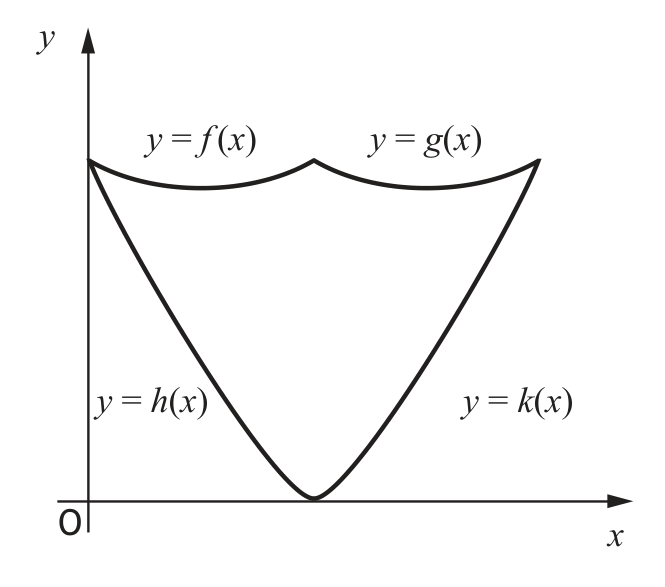
The edges of the wall plaque can be modelled by parts of the graphs of four quadratic functions as shown in the sketch.

Wall plaque shape

f(x)=14x212x+3\displaystyle \bullet \quad f(x)=\frac{1}{4}x^{2}-\frac{1}{2}x+3
g(x)=14x232x+5\displaystyle \bullet \quad g(x)=\frac{1}{4}x^{2}-\frac{3}{2}x+5
h(x)=38x294x+3\displaystyle \bullet \quad h(x)=\frac{3}{8}x^{2}-\frac{9}{4}x+3
k(x)=38x234x\displaystyle \bullet \quad k(x)=\frac{3}{8}x^{2}-\frac{3}{4}x

(a)  Find the x-coordinate of the point of intersection of the graphs with equations y=f(x)\displaystyle y=f(x) and y=g(x)\displaystyle y=g(x).
The graphs of the functions f(x)\displaystyle f(x) and h(x)\displaystyle h(x) intersect on the y-axis. The plaque has a vertical line of symmetry.
(b)  Calculate the area of the wall plaque.

Show answer
(a) x=2\displaystyle x=2
(b) 193\displaystyle \frac{19}{3} square units
5

Question 5

Intersections of two circlesCircle equation from radius/centre or vice versa
(4, 4)8 Marks
2015 P2 Q5

Circle C1\displaystyle C_{1} has equation
x2+y2+6x+10y+9=0\displaystyle x^{2}+y^{2}+6x+10y+9=0
The centre of circle C2\displaystyle C_{2} is (9,11)\displaystyle (9, 11)
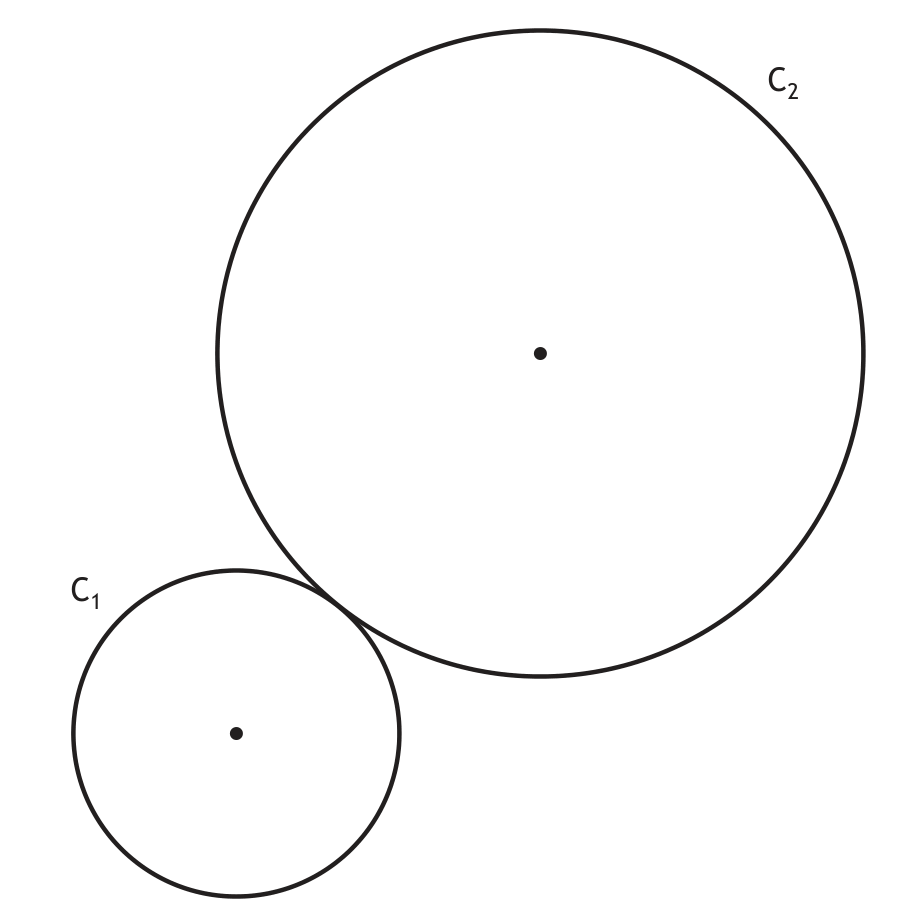
Circles C1\displaystyle C_{1} and C2\displaystyle C_{2} touch externally.

Circles C1 and C2

(a)  Determine the radius of C2.\displaystyle C_{2}.
(b)  A third circle, C3\displaystyle C_{3}, is drawn such that both C1\displaystyle C_{1} and C2\displaystyle C_{2} touch C3\displaystyle C_{3} internally and the centres of C1\displaystyle C_{1}, C2\displaystyle C_{2} and C3\displaystyle C_{3} are collinear.
Determine the equation of C3.\displaystyle C_{3}.

Show answer
(a) 15
(b) (x6)2+(y7)2=400\displaystyle (x-6)^{2}+(y-7)^{2}=400
6

Question 6

Using the distributive law with the scalar productVector pathways in geometric diagrams
(3, 1, 3)7 Marks
2015 P2 Q6

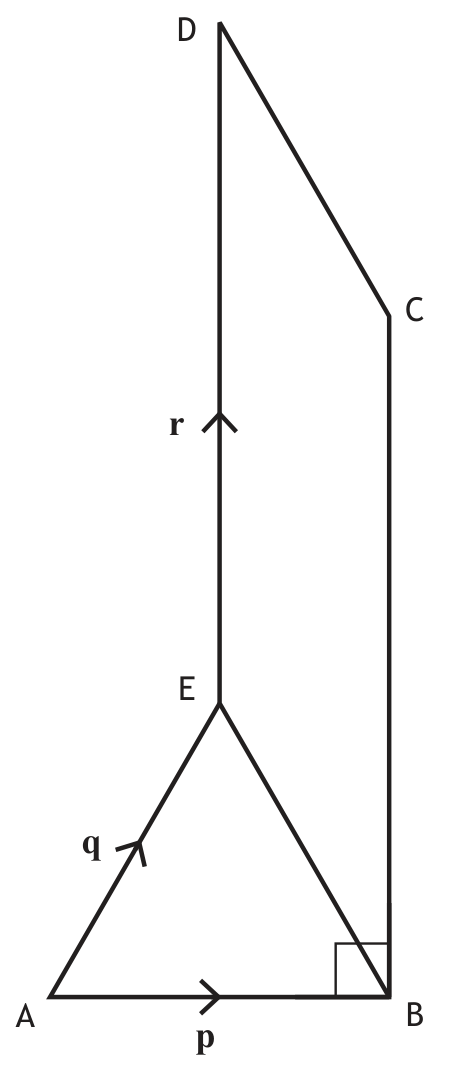
Vectors p,q\displaystyle \mathbf{p}, \mathbf{q} and r\displaystyle \mathbf{r} are represented on the diagram as shown.
•  BCDE is a parallelogram
•  ABE is an equilateral triangle
p=3\displaystyle \bullet \quad |\mathbf{p}|=3
•  Angle ABC=90\displaystyle ABC=90^{\circ}

Vectors diagram

(a)  Evaluate p.(q+r).\displaystyle \mathbf{p}.(\mathbf{q}+\mathbf{r}).
(b)  Express EC\displaystyle \vec{EC} in terms of p,q\displaystyle \mathbf{p}, \mathbf{q} and r.\displaystyle \mathbf{r}.
(c)  Given that AE.EC=9392\displaystyle \vec{AE}.\vec{EC}=9\sqrt{3}-\frac{9}{2}, find r.\displaystyle |\mathbf{r}|.

Show answer
(a) 4.5\displaystyle 4.5
(b) pq+r\displaystyle \mathbf{p}-\mathbf{q}+\mathbf{r}
(c) r=6\displaystyle |\mathbf{r}|=6
7

Question 7

Integrate (definite or indefinite): trigonometric expressionApply double angle formula to simplify or evaluate
(2, 2, 2)6 Marks
2015 P2 Q7

(a)  Find (3cos2x+1)dx.\displaystyle \int(3 \cos 2x+1)dx.
(b)  Show that
3cos2x+1=4cos2x2sin2x\displaystyle 3 \cos 2x+1=4 \cos^{2}x-2 \sin^{2}x
(c)  Hence, or otherwise, find
(sin2x2cos2x)dx.\displaystyle \int(\sin^{2}x-2 \cos^{2}x)dx.

Show answer
(a) 32sin2x+x+c\displaystyle \frac{3}{2}\sin 2x + x + c
(b) Proof
(c) 34sin2x12x+c\displaystyle -\frac{3}{4}\sin 2x - \frac{1}{2}x + c
8

Question 8

Optimisation
(1, 1, 8)10 Marks
2015 P2 Q8

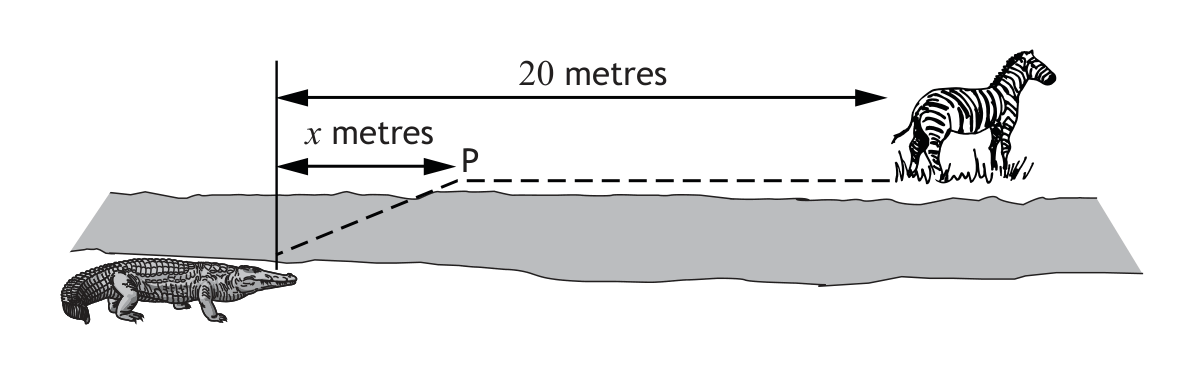
A crocodile is stalking prey located 20 metres further upstream on the opposite bank of a river.
Crocodiles travel at different speeds on land and in water.
The time taken for the crocodile to reach its prey can be minimised if it swims to a particular point, P, x\displaystyle x metres upstream on the other side of the river as shown in the diagram.

Crocodile stalking prey

The time taken, T\displaystyle T, measured in tenths of a second, is given by
T(x)=536+x2+4(20x)\displaystyle T(x)=5\sqrt{36+x^{2}}+4(20-x)

(a)  (i) Calculate the time taken if the crocodile does not travel on land.
      (ii) Calculate the time taken if the crocodile swims the shortest distance possible.
(b)  Between these two extremes there is one value of x\displaystyle x which minimises the time taken. Find this value of x\displaystyle x and hence calculate the minimum possible time.

Show answer
(a)(i) 104 tenths of a second
(ii) 110 tenths of a second
(b) x=8\displaystyle x=8, minimum time 98 tenths of a second
9

Question 9

Apply compound angle formula to simplify or evaluateWave function (y = asin x ± bcosx)
8 Marks
2015 P2 Q9

The blades of a wind turbine are turning at a steady rate.
The height, h\displaystyle h metres, of the tip of one of the blades above the ground at time, t\displaystyle t seconds, is given by the formula
h=36sin(1.5t)15cos(1.5t)+65\displaystyle h=36 \sin(1.5t)-15 \cos(1.5t)+65
Express
36sin(1.5t)15cos(1.5t)\displaystyle 36 \sin(1.5t)-15 \cos(1.5t)
in the form ksin(1.5ta)\displaystyle k \sin(1.5t-a), where k>0\displaystyle k \gt 0 and 0<a<π2\displaystyle 0 \lt a \lt \frac{\pi}{2}, and hence find the two values of t\displaystyle t for which the tip of this blade is at a height of 100 metres above the ground during the first turn.

Show answer
k=39,a=0.395\displaystyle k=39, a=0.395 rad (or 22.6\displaystyle 22.6^{\circ})
t=1.006\displaystyle t=1.006 s and t=1.615\displaystyle t=1.615 s