Higher Maths · SQA past paper

2016 Paper 1

Non-Calculator · 15 questions
1

Question 1

Perpendicular and parallel lines
2 Marks
2016 P1 Q1
Find the equation of the line passing through the point (2,3)\displaystyle (-2, 3) which is parallel to the line with equation
y+4x=7.\displaystyle y+4x=7.
Show answer
y+4x=5\displaystyle y+4x=-5 or y=4x5\displaystyle y=-4x-5
2

Question 2

Differentiate or evaluate derivative: polynomial
3 Marks
2016 P1 Q2
Given that
y=12x3+8x\displaystyle y=12x^{3}+8\sqrt{x} where x>0\displaystyle x \gt 0,
find dydx.\displaystyle \frac{dy}{dx}.
Show answer
36x2+4x12\displaystyle 36x^{2}+4x^{-\frac{1}{2}} or 36x2+4x\displaystyle 36x^{2}+\frac{4}{\sqrt{x}}
3

Question 3

Find a specific term of a recurrence relationLimits of recurrence relations
(1, 1, 2)4 Marks
2016 P1 Q3

A sequence is defined by the recurrence relation
un+1=13un+10\displaystyle u_{n+1}=\frac{1}{3}u_{n}+10
with u3=6.\displaystyle u_{3}=6.

(a)  Find the value of u4.\displaystyle u_{4}.
(b)  Explain why this sequence approaches a limit as n.\displaystyle n\rightarrow\infty.
(c)  Calculate this limit.

Show answer
(a) 12
(b) A limit exists because 1<13<1\displaystyle -1 \lt \frac{1}{3} \lt 1
(c) 15
4

Question 4

Circle equation from radius/centre or vice versa
3 Marks
2016 P1 Q4

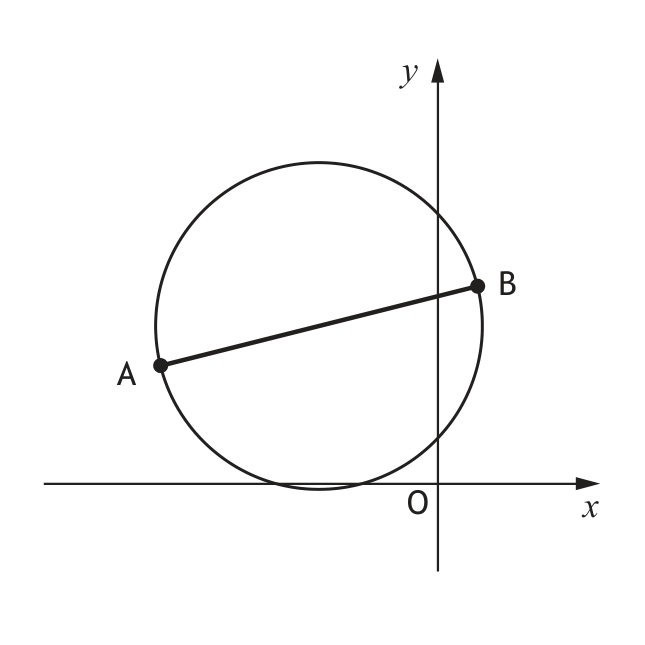
A and B are the points (7,3)\displaystyle (-7, 3) and (1,5).\displaystyle (1, 5).
AB is a diameter of a circle.

Circle with diameter AB

Find the equation of this circle.

Show answer
(x+3)2+(y4)2=17\displaystyle (x+3)^{2}+(y-4)^{2}=17
5

Question 5

Integrate (definite or indefinite): trigonometric expression
2 Marks
2016 P1 Q5
Find
8cos(4x+1)dx.\displaystyle \int8 \cos(4x+1)dx.
Show answer
2sin(4x+1)+c\displaystyle 2 \sin(4x+1)+c
6

Question 6

Inverse functions
(3, 1)4 Marks
2016 P1 Q6

Functions f\displaystyle f and g\displaystyle g are defined on R\displaystyle \mathbb{R}, the set of real numbers.
The inverse functions f1\displaystyle f^{-1} and g1\displaystyle g^{-1} both exist.

(a)  Given f(x)=3x+5\displaystyle f(x)=3x+5 find f1(x).\displaystyle f^{-1}(x).
(b)  If g(2)=7\displaystyle g(2)=7, write down the value of g1(7).\displaystyle g^{-1}(7).

Show answer
(a) f1(x)=x53\displaystyle f^{-1}(x)=\frac{x-5}{3}
(b) 2
7

Question 7

Vector pathways in geometric diagrams
(2, 2)4 Marks
2016 P1 Q7

Three vectors can be expressed as follows:

FG=2i6j+3k\displaystyle \vec{FG}=-2\mathbf{i}-6\mathbf{j}+3\mathbf{k}
GH=3i+9j7k\displaystyle \vec{GH}=3\mathbf{i}+9\mathbf{j}-7\mathbf{k}
EH=2i+3j+k\displaystyle \vec{EH}=2\mathbf{i}+3\mathbf{j}+\mathbf{k}

(a)  Find FH\displaystyle \vec{FH}.
(b)  Hence, or otherwise, find FE\displaystyle \vec{FE}.

Show answer
(a) i+3j4k\displaystyle \mathbf{i}+3\mathbf{j}-4\mathbf{k}
(b) i5k\displaystyle -\mathbf{i}-5\mathbf{k}
8

Question 8

Intersections of lines and circles (including showing tangency)
5 Marks
2016 P1 Q8
Show that the line with equation y=3x5\displaystyle y=3x-5 is a tangent to the circle with equation
x2+y2+2x4y5=0\displaystyle x^{2}+y^{2}+2x-4y-5=0
and find the coordinates of the point of contact.
Show answer
Proof (discriminant is 0 or repeated roots). Point of contact (2,1).\displaystyle (2, 1).
9

Question 9

Find stationary points and determine natureQuadratic inequations
(4, 2)6 Marks
2016 P1 Q9

(a)  Find the x-coordinates of the stationary points on the graph with equation y=f(x)\displaystyle y=f(x) where
f(x)=x3+3x224x\displaystyle f(x)=x^{3}+3x^{2}-24x
(b)  Hence determine the range of values of x\displaystyle x for which the function f\displaystyle f is strictly increasing.

Show answer
(a) x=4\displaystyle x=-4 and x=2\displaystyle x=2
(b) x<4\displaystyle x \lt -4 and x>2\displaystyle x \gt 2
10

Question 10

Graphs of logarithmic or exponential functions
2 Marks
2016 P1 Q10

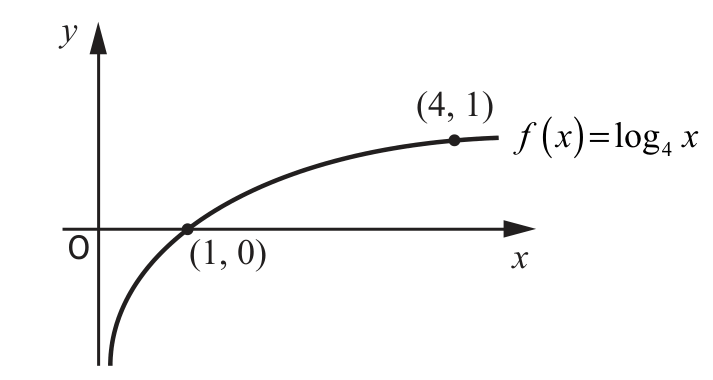
The diagram below shows the graph of the function f(x)=log4x\displaystyle f(x)=\log_{4}x, where x>0.\displaystyle x \gt 0.

Graph of f(x)=log4x passing through (1,0) and (4,1)

The inverse function, f1\displaystyle f^{-1}, exists.
On the diagram in your answer booklet, sketch the graph of the inverse function.

Show answer
Sketch of y=4x\displaystyle y=4^x passing through (0,1)\displaystyle (0, 1) and (1,4).\displaystyle (1, 4).
11

Question 11

Ratio in which one point divides two others
(2, 3)5 Marks
2016 P1 Q11

(a)  A and C are the points (1,3,2)\displaystyle (1, 3, -2) and (4,3,4)\displaystyle (4, -3, 4) respectively.
Point B divides AC in the ratio 1 : 2.
Find the coordinates of B.
(b)  kAC\displaystyle k\vec{AC} is a vector of magnitude 1, where k>0.\displaystyle k \gt 0.
Determine the value of k.\displaystyle k.

Show answer
(a) (2,1,0)\displaystyle (2, 1, 0)
(b) k=19\displaystyle k=\frac{1}{9}
12

Question 12

Composite functionsCompleting the square
(2, 3)5 Marks
2016 P1 Q12

The functions f\displaystyle f and g\displaystyle g are defined on R\displaystyle \mathbb{R}, the set of real numbers by
f(x)=2x24x+5\displaystyle f(x)=2x^{2}-4x+5 and g(x)=3x\displaystyle g(x)=3-x

(a)  Given h(x)=f(g(x))\displaystyle h(x)=f(g(x)), show that h(x)=2x28x+11.\displaystyle h(x)=2x^{2}-8x+11.
(b)  Express h(x)\displaystyle h(x) in the form p(x+q)2+r.\displaystyle p(x+q)^{2}+r.

Show answer
(a) Proof
(b) 2(x2)2+3\displaystyle 2(x-2)^{2}+3
13

Question 13

Apply compound angle formula to simplify or evaluate
5 Marks
2016 P1 Q13

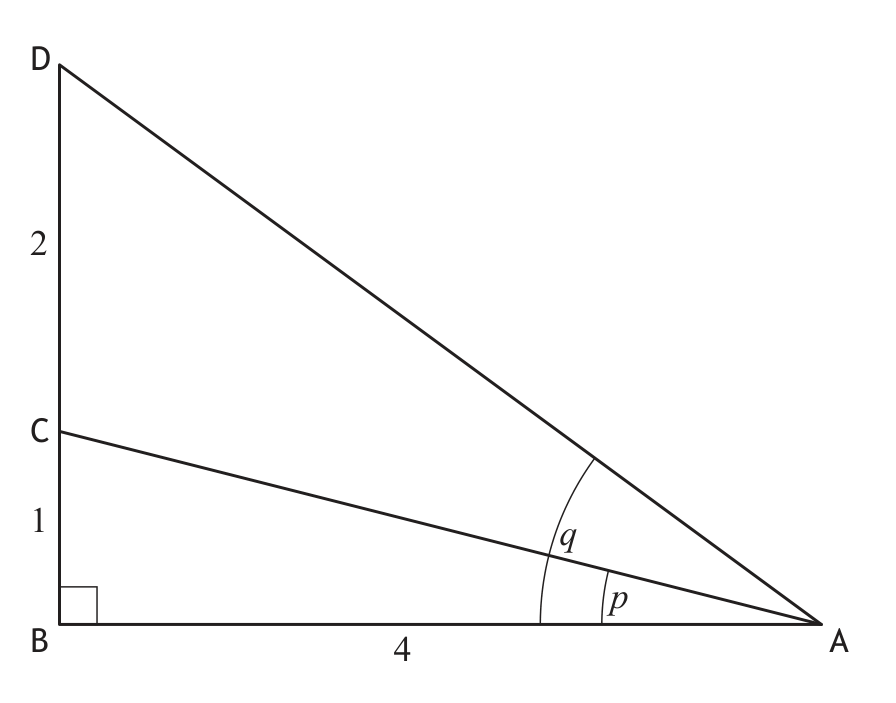
Triangle ABD is right-angled at B with angles BAC=p\displaystyle BAC=p and BAD=q\displaystyle BAD=q and lengths as shown in the diagram below.

Triangle ABD with right angle at B

Show that the exact value of cos(qp)\displaystyle \cos(q-p) is 191785.\displaystyle \frac{19\sqrt{17}}{85}.

Show answer
Proof showing cos(qp)=191785\displaystyle \cos(q-p) = \frac{19\sqrt{17}}{85}
14

Question 14

Simplify numerical expression involving logs/exponentialsSolving equations containing a logarithm
(1, 5)6 Marks
2016 P1 Q14

(a)  Evaluate log525.\displaystyle \log_{5} 25.

(b)  Hence solve
log4x+log4(x6)=log525\displaystyle \log_{4}x+\log_{4}(x-6)=\log_{5}25
where x>6.\displaystyle x \gt 6.

Show answer
(a) 2
(b) x=8\displaystyle x=8
15

Question 15

Identify polynomial equation when shown graph/rootsIdentifying/sketching graphs of related functions (non-trigonometric)
(3, 1)4 Marks
2016 P1 Q15

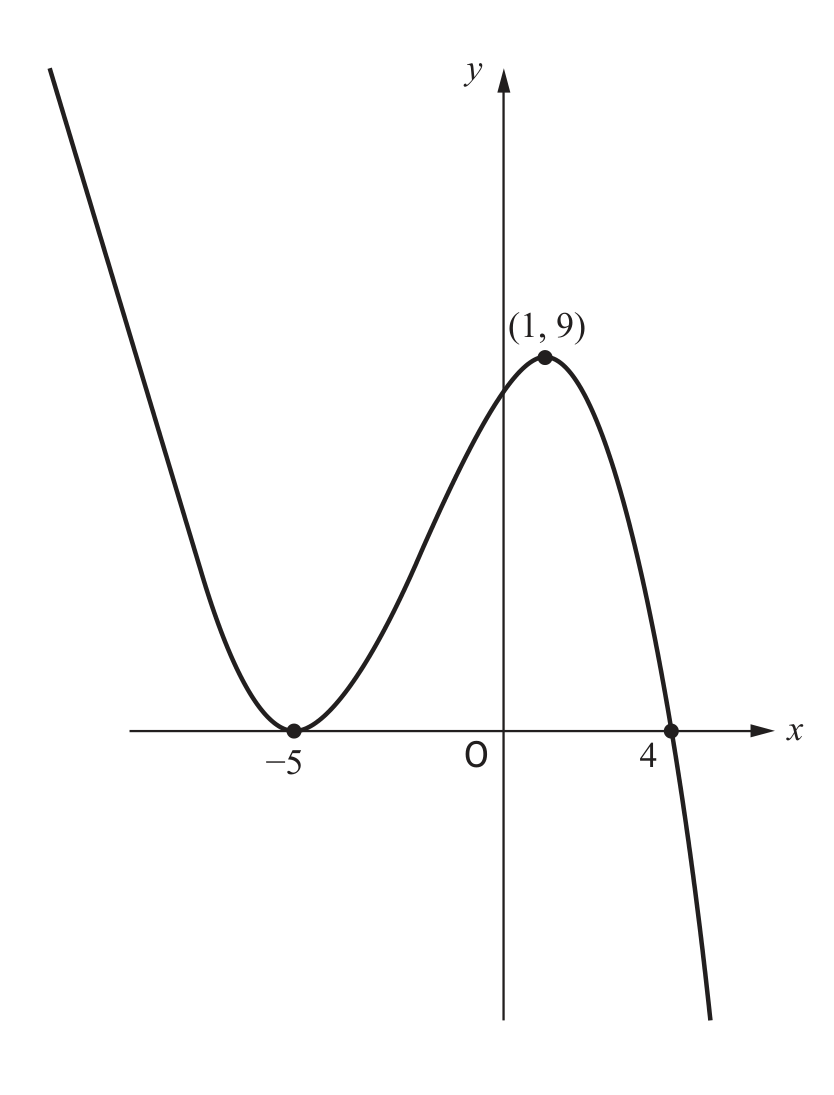
The diagram below shows the graph with equation y=f(x)\displaystyle y=f(x), where
f(x)=k(xa)(xb)2\displaystyle f(x)=k(x-a)(x-b)^{2}

Graph of f(x) with roots at -5 and 4

(a)  Find the values of a\displaystyle a, b\displaystyle b and k.\displaystyle k.
(b)  For the function g(x)=f(x)d\displaystyle g(x)=f(x)-d, where d\displaystyle d is positive, determine the range of values of d\displaystyle d for which g(x)\displaystyle g(x) has exactly one real root.

Show answer
(a) a=4,b=5,k=112\displaystyle a=4, b=-5, k=-\frac{1}{12}
(b) d>9\displaystyle d \gt 9