Higher Maths · SQA past paper

2019 Paper 1

Non-Calculator · 17 questions
1

Question 1

Find stationary points and determine nature
4 Marks
2019 P1 Q1
Find the x-coordinates of the stationary points on the curve with equation
y=12x42x3+6.\displaystyle y=\frac{1}{2}x^{4}-2x^{3}+6.
Show answer
x=0\displaystyle x=0 and x=3\displaystyle x=3
2

Question 2

Discriminant and Quadratics
3 Marks
2019 P1 Q2
The equation x2+(k5)x+1=0\displaystyle x^{2}+(k-5)x+1=0 has equal roots.
Determine the possible values of k.\displaystyle k.
Show answer
k=3\displaystyle k=3, k=7\displaystyle k=7
3

Question 3

Circle equation from radius/centre or vice versa
2 Marks
2019 P1 Q3
Circle C1\displaystyle C_{1} has equation
x2+y26x2y26=0\displaystyle x^{2}+y^{2}-6x-2y-26=0
Circle C2\displaystyle C_{2} has centre (4,2)\displaystyle (4,-2).
The radius of C2\displaystyle C_{2} is equal to the radius of C1\displaystyle C_{1}.
Find the equation of circle C2\displaystyle C_{2}.
Show answer
(x4)2+(y+2)2=36\displaystyle (x-4)^{2}+(y+2)^{2}=36
4

Question 4

Go backwards to find recurrence relation when terms known
(3, 1)4 Marks
2019 P1 Q4

A sequence is generated by the recurrence relation un+1=mun+c\displaystyle u_{n+1}=mu_{n}+c, where the first three terms of the sequence are 6, 9 and 11.

(a)  Find the values of m\displaystyle m and c.\displaystyle c.
(b)  Hence, calculate the fourth term of the sequence.

Show answer
(a) m=23\displaystyle m=\frac{2}{3}, c=5\displaystyle c=5
(b) u4=373\displaystyle u_{4}=\frac{37}{3} (or 1213\displaystyle 12\frac{1}{3})
5

Question 5

Collinearity (in 3d or 2d)Ratio in which one point divides two others
(3, 1)4 Marks
2019 P1 Q5

(a)  Show that the points A(1,5,3)\displaystyle A(1,5,-3), B(4,1,0)\displaystyle B(4,-1,0) and C(8,9,4)\displaystyle C(8,-9,4) are collinear.
(b)  State the ratio in which B divides AC.

Show answer
(a) Proof (showing vectors are parallel and share a common point)
(b) 3:4
6

Question 6

Differentiate or evaluate derivative: composite function
3 Marks
2019 P1 Q6
Given that
y=1(13x)5\displaystyle y=\frac{1}{(1-3x)^{5}}, x13\displaystyle x\ne\frac{1}{3}
find dydx.\displaystyle \frac{dy}{dx}.
Show answer
15(13x)6\displaystyle 15(1-3x)^{-6} or 15(13x)6\displaystyle \frac{15}{(1-3x)^{6}}
7

Question 7

Perpendicular and parallel linesAngles and straight lines: m = tanθ
4 Marks
2019 P1 Q7
The line, L, makes an angle of 30\displaystyle 30^{\circ} with the positive direction of the x-axis.
Find the equation of the line perpendicular to L, passing through (0,4)\displaystyle (0,-4).
Show answer
y=3x4\displaystyle y=-\sqrt{3}x-4
8

Question 8

Areas using integration
(1, 3)4 Marks
2019 P1 Q8

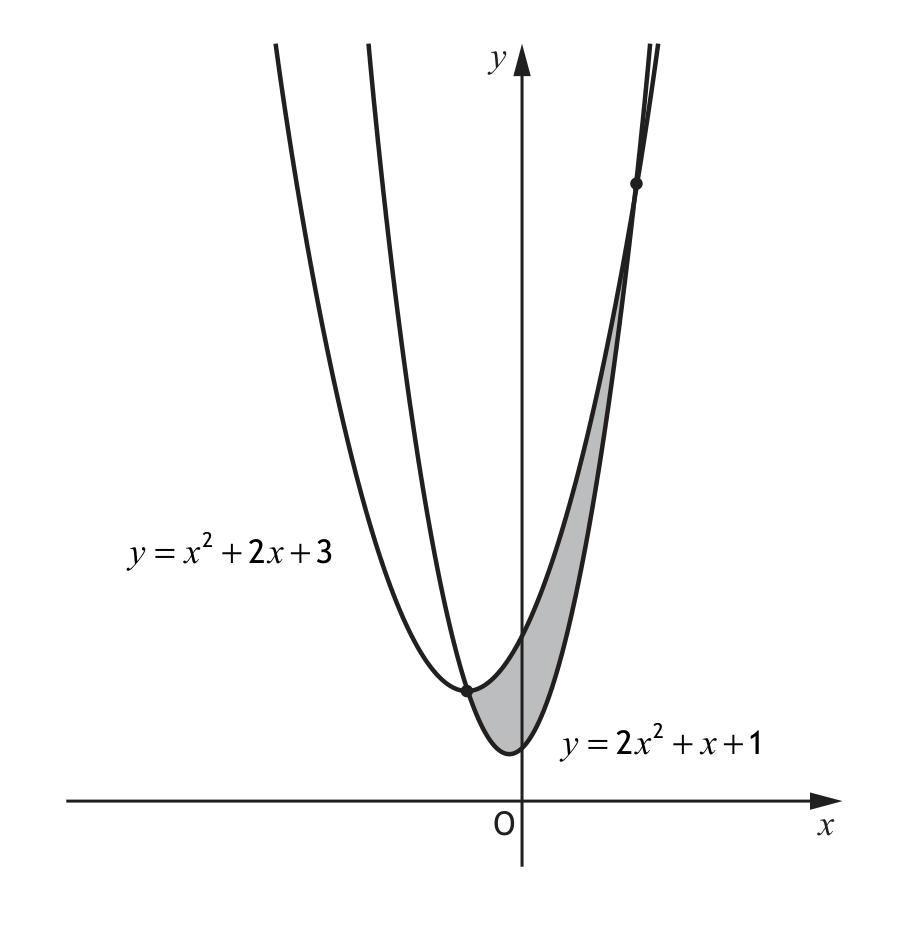
The graphs of y=x2+2x+3\displaystyle y=x^{2}+2x+3 and y=2x2+x+1\displaystyle y=2x^{2}+x+1 are shown below. The graphs intersect at the points where x=1\displaystyle x=-1 and x=2\displaystyle x=2.

Graphs of two parabolas intersecting

(a)  Express the shaded area, enclosed between the curves, as an integral.
(b)  Evaluate the shaded area.

Show answer
(a) 12(x2+x+2)dx\displaystyle \int_{-1}^{2}(-x^{2}+x+2)dx
(b) 92\displaystyle \frac{9}{2}
9

Question 9

Perpendicular vectors and the scalar product
(1, 3, 2)6 Marks
2019 P1 Q9

Vectors u\displaystyle \mathbf{u} and v\displaystyle \mathbf{v} have components
(p24)\displaystyle \begin{pmatrix}p\\-2\\4\end{pmatrix} and (2p+1636)\displaystyle \begin{pmatrix}2p+16\\-3\\6\end{pmatrix}
pR.\displaystyle p\in\mathbb{R}.

(a)  (i) Find an expression for uv.\displaystyle \mathbf{u}\cdot\mathbf{v}.
      (ii) Determine the values of p\displaystyle p for which u\displaystyle \mathbf{u} and v\displaystyle \mathbf{v} are perpendicular.
(b)  Determine the value of p\displaystyle p for which u\displaystyle \mathbf{u} and v\displaystyle \mathbf{v} are parallel.

Show answer
(a)(i) 2p2+16p+30\displaystyle 2p^{2}+16p+30
(a)(ii) p=5\displaystyle p=-5, p=3\displaystyle p=-3
(b) p=32\displaystyle p=-32
10

Question 10

Identifying/sketching graphs of related functions (non-trigonometric)
(1, 1)2 Marks
2019 P1 Q10

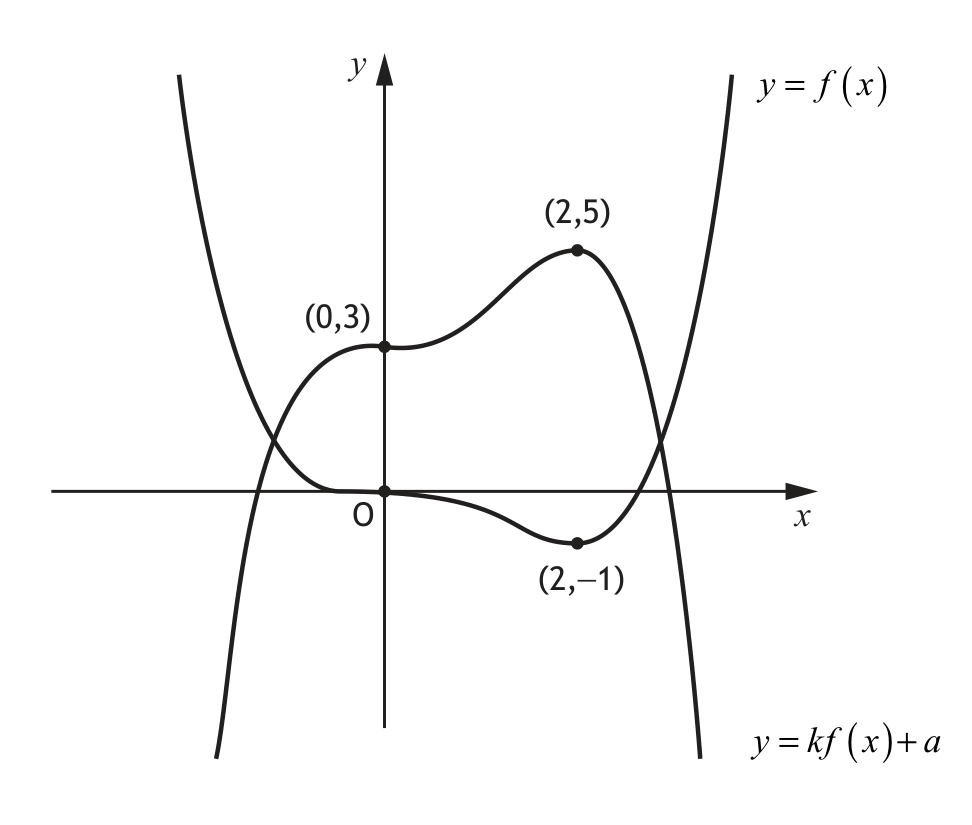
The diagram shows the graphs with equations y=f(x)\displaystyle y=f(x) and y=kf(x)+a.\displaystyle y=kf(x)+a.

Graphs of f(x) and transformed function kf(x)+a

(a)  State the value of a.\displaystyle a.
(b)  Find the value of k.\displaystyle k.

Show answer
(a) a=3\displaystyle a=3
(b) k=2\displaystyle k=-2
11

Question 11

Integrate (definite or indefinite): trigonometric expression
4 Marks
2019 P1 Q11
Evaluate
0π9cos(3xπ6)dx.\displaystyle \int_{0}^{\frac{\pi}{9}}\cos(3x-\frac{\pi}{6})dx.
Show answer
13\displaystyle \frac{1}{3}
12

Question 12

Domain and rangeComposite functions
(2, 1)3 Marks
2019 P1 Q12

Functions f\displaystyle f and g\displaystyle g are defined by
f(x)=1x\displaystyle f(x)=\frac{1}{\sqrt{x}}, where x>0\displaystyle x \gt 0
and
g(x)=5x\displaystyle g(x)=5-x, where xR.\displaystyle x\in\mathbb{R}.
(a)  Determine an expression for f(g(x)).\displaystyle f(g(x)).
(b)  State the range of values of x\displaystyle x for which f(g(x))\displaystyle f(g(x)) is undefined.

Show answer
(a) 15x\displaystyle \frac{1}{\sqrt{5-x}}
(b) x5\displaystyle x\ge 5
13

Question 13

Apply compound angle formula to simplify or evaluate
(1, 1, 3)5 Marks
2019 P1 Q13

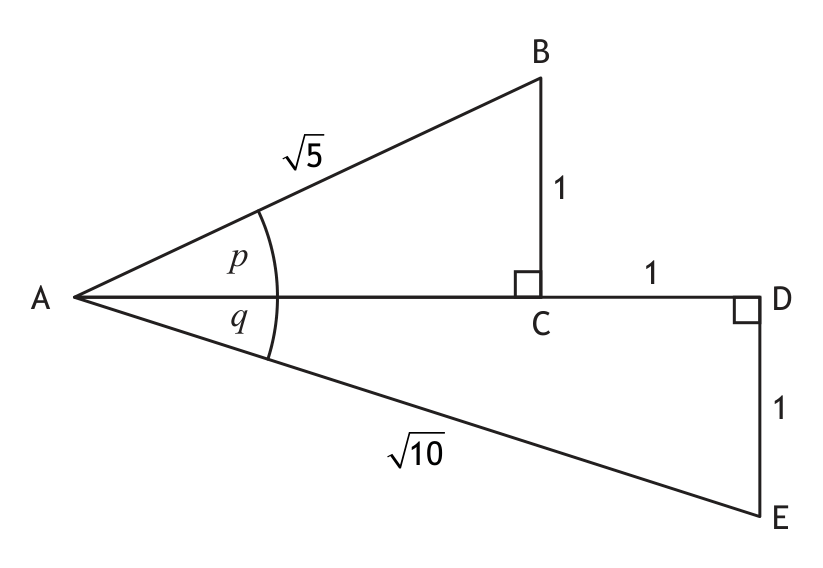
Triangles ABC and ADE are both right angled. Angles p\displaystyle p and q\displaystyle q are as shown in the diagram.

Right angled triangles ABC and ADE with angles p and q

(a)  Determine the value of:
      (i) cosp\displaystyle \cos p
      (ii) cosq\displaystyle \cos q
(b)  Hence determine the value of sin(p+q).\displaystyle \sin(p+q).

Show answer
(a)(i) 25\displaystyle \frac{2}{\sqrt{5}}, (ii) 310\displaystyle \frac{3}{\sqrt{10}}
(b) 12\displaystyle \frac{1}{\sqrt{2}} (or 22\displaystyle \frac{\sqrt{2}}{2})
14

Question 14

Simplify numerical expression involving logs/exponentialsSolving equations containing a logarithm
(3, 3)6 Marks
2019 P1 Q14

(a)  Evaluate
log104+2log105.\displaystyle \log_{10}4+2\log_{10}5.

(b)  Solve
log2(7x2)log23=5\displaystyle \log_{2}(7x-2)-\log_{2}3=5
x1.\displaystyle x \ge 1.

Show answer
(a) 2
(b) x=14\displaystyle x=14
15

Question 15

Solving a trigonometric equation using formula for sin(2x)
(4, 1)5 Marks
2019 P1 Q15

(a)  Solve the equation
sin2x+6cosx=0\displaystyle \sin 2x^{\circ}+6\cos x^{\circ}=0
for 0x<360.\displaystyle 0\le x \lt 360.
(b)  Hence solve
sin4x+6cos2x=0\displaystyle \sin 4x^{\circ}+6\cos 2x^{\circ}=0
for 0x<360.\displaystyle 0\le x \lt 360.

Show answer
(a) 90, 270, no solutions
(b) 45, 135, 225, 315
16

Question 16

Quadratic inequations
(2, 4)6 Marks
2019 P1 Q16

The point P has coordinates (4,k)\displaystyle (4,k). C\displaystyle C is the centre of the circle with equation
(x1)2+(y+2)2=25\displaystyle (x-1)^{2}+(y+2)^{2}=25
(a)  Show that the distance between the points P and C is given by k2+4k+13.\displaystyle \sqrt{k^{2}+4k+13}.
(b)  Hence, or otherwise, find the range of values of k\displaystyle k such that P lies outside the circle.

Show answer
(a) Proof
(b) k<6\displaystyle k \lt -6 or k>2\displaystyle k \gt 2
17

Question 17

Proving a trigonometric identity
(3, 2)5 Marks
2019 P1 Q17

(a)  Express (sinxcosx)2\displaystyle (\sin x-\cos x)^{2} in the form p+qsinrx\displaystyle p+q\sin rx where p,q\displaystyle p,q and r\displaystyle r are integers.
(b)  Hence, find (sinxcosx)2dx.\displaystyle \int(\sin x-\cos x)^{2}dx.

Show answer
(a) 1sin2x\displaystyle 1-\sin 2x
(b) x+12cos2x+c\displaystyle x+\frac{1}{2}\cos 2x+c