Higher Maths · SQA past paper

2025 Paper 1

Non-Calculator · 13 questions
1

Question 1

Equation of a tangent to a curve
4 Marks
2025 P1 Q1
A curve has equation y=x32x2+5\displaystyle y=x^{3}-2x^{2}+5.
Find the equation of the tangent to this curve at the point where x=2\displaystyle x=2.
Show answer
y=4x3\displaystyle y=4x-3
2

Question 2

Perpendicular and parallel lines
4 Marks
2025 P1 Q2
Find the equation of the perpendicular bisector of the line joining A(1,4)\displaystyle A(1,4) and B(9,10).\displaystyle B(9,10).
Show answer
3y=4x+41\displaystyle 3y=-4x+41
3

Question 3

Integrate (definite or indefinite): polynomial
4 Marks
2025 P1 Q3
Find
(12x2+x12)dx,x>0.\displaystyle \int(\frac{12}{x^{2}}+x^{\frac{1}{2}})dx,x \gt 0.
Show answer
12x1+23x32+c\displaystyle -12x^{-1}+\frac{2}{3}x^{\frac{3}{2}}+c
4

Question 4

Simplify numerical expression involving logs/exponentials
3 Marks
2025 P1 Q4
Evaluate
3log32+log3124.\displaystyle 3\log_{3}2+\log_{3}\frac{1}{24}.
Show answer
-1
5

Question 5

Identifying/sketching graphs of related functions (non-trigonometric)
2 Marks
2025 P1 Q5

The diagram shows the graph of y=f(x)\displaystyle y=f(x), with stationary points at (0, 3) and (4, 0).
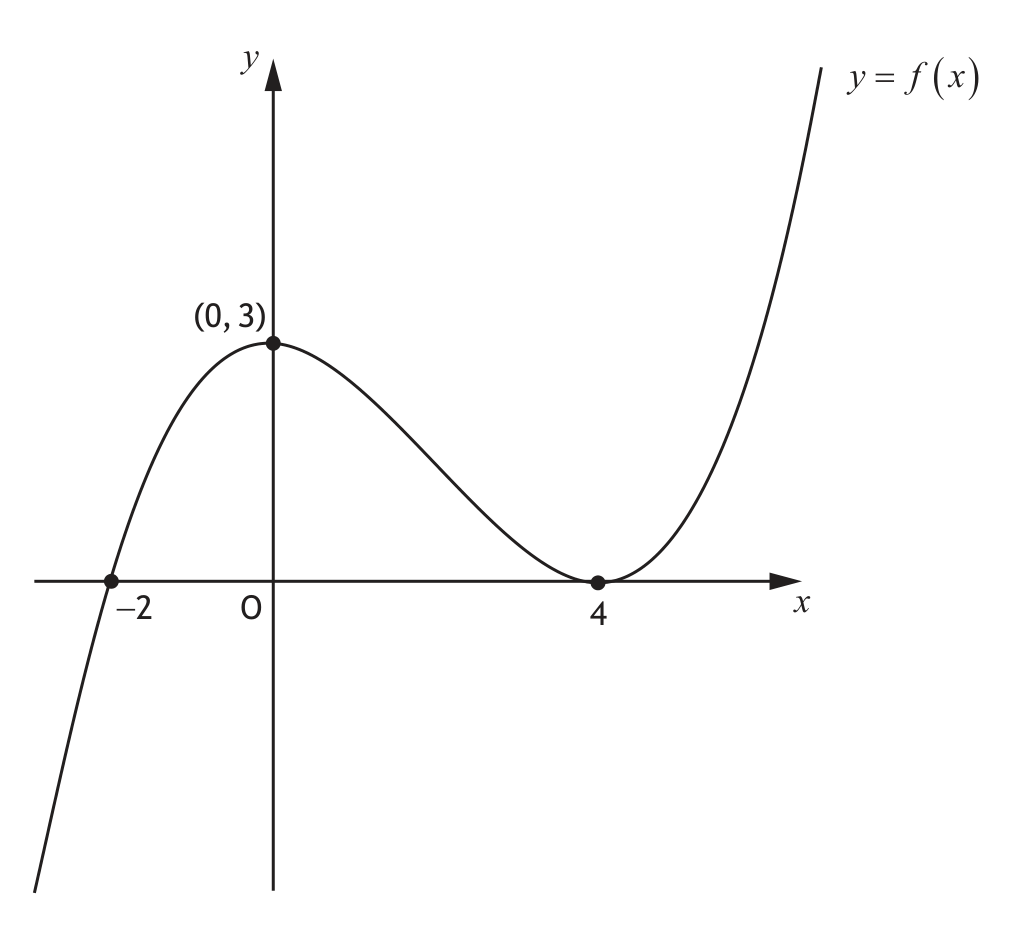
Graph of y=f(x) with stationary points at (0,3) and (4,0)

On the diagram in your answer booklet, sketch the graph of y=f(x)+3\displaystyle y=f(-x)+3.

Show answer
Sketch showing graph reflected in y-axis and translated 3 units up. Stationary points at (0,6) and (-4,3).
6

Question 6

Apply double angle formula to simplify or evaluateApply compound angle formula to simplify or evaluate
(3, 1, 3)7 Marks
2025 P1 Q6

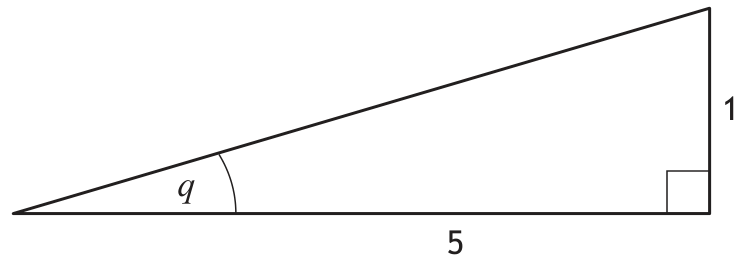
The diagram shows a right-angled triangle with angle q.
Right-angled triangle with sides 1, 5 and angle q

(a) Determine the value of:
(i) sin2q\displaystyle \sin 2q
(ii) cos2q\displaystyle \cos 2q.
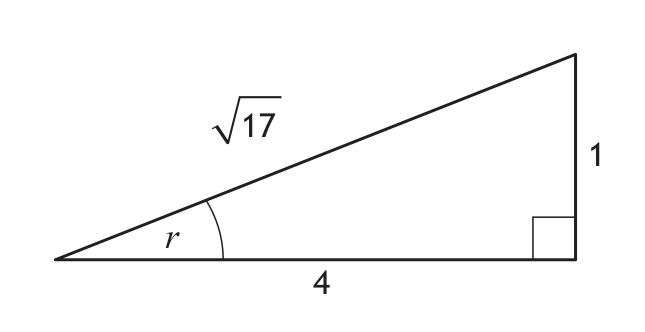
A second right-angled triangle has angle r\displaystyle r as shown.

Right-angled triangle with sides 4, 1 and angle r

(b) Find the value of sin(2qr)\displaystyle \sin(2q-r)

Show answer
(a)(i) 513\displaystyle \frac{5}{13} (ii) 1213\displaystyle \frac{12}{13}
(b) 81317\displaystyle \frac{8}{13\sqrt{17}}
7

Question 7

Cubic/quartic expressions/equations: factorise or solve
(2, 3)5 Marks
2025 P1 Q7

(a) Show that (x+3)\displaystyle (x+3) is a factor of 5x3+16x2x12\displaystyle 5x^{3}+16x^{2}-x-12
(b) Hence, or otherwise, solve
5x3+16x2x12=0.\displaystyle 5x^{3}+16x^{2}-x-12=0.

Show answer
(a) Proof using synthetic division showing remainder is 0.
(b) x=3,1,45\displaystyle x=-3, -1, \frac{4}{5}
8

Question 8

Solving equations containing a logarithm
3 Marks
2025 P1 Q8
Given that
loga75=2+loga3\displaystyle \log_{a}75=2+\log_{a}3 where a>0\displaystyle a \gt 0,
find the value of a.\displaystyle a.
Show answer
a=5\displaystyle a = 5
9

Question 9

Intersections of lines and circles (including showing tangency)
4 Marks
2025 P1 Q9

Find the coordinates of the points of intersection of the line with equation y=x+1\displaystyle y=x+1 and the circle with equation
x2+y22x+6y15=0\displaystyle x^{2}+y^{2}-2x+6y-15=0

Show answer
(1, 2) and (-4, -3)
10

Question 10

Scalar product
5 Marks
2025 P1 Q10

The vectors u and v are such that:
u=(110)\displaystyle u=\begin{pmatrix}1\\ 1\\ 0\end{pmatrix}
v=(13k)\displaystyle v=\begin{pmatrix}1\\ 3\\ k\end{pmatrix}
the angle between u and v is 45\displaystyle 45^{\circ}.
Find the value of k, where k>0\displaystyle k \gt 0.

Show answer
k=6\displaystyle k=\sqrt{6}
11

Question 11

Discriminant and QuadraticsQuadratic inequations
4 Marks
2025 P1 Q11

The equation 9x2+3kx+k=0\displaystyle 9x^{2}+3kx+k=0 has two real and distinct roots.
Determine the range of values for k.
Justify your answer.

Show answer
k<0\displaystyle k \lt 0 and k>4\displaystyle k \gt 4
12

Question 12

Differential equationIntegrate (definite or indefinite): trigonometric expression
4 Marks
2025 P1 Q12

Given that:
dydx=6 cos x+8 sin 2x\displaystyle \frac{dy}{dx}=6~\cos~x+8~\sin~2x
and y=4\displaystyle y=4 when x=π6\displaystyle x=\frac{\pi}{6}
express y in terms of x.

Show answer
y=6sinx4cos2x+3\displaystyle y=6\sin x - 4\cos 2x + 3
13

Question 13

Find stationary points and determine nature
(3, 3)6 Marks
2025 P1 Q13

A function, f, is defined on the set of real numbers.
The derivative of f is f(x)=(x+5)(2x)\displaystyle f^{\prime}(x)=(x+5)(2-x)
(a) Find the x-coordinates of the stationary points on the curve with equation y=f(x)\displaystyle y=f(x) and determine their nature.
It is known that:
•  f is a cubic function
•  f(0)<0\displaystyle f(0) \lt 0
•  the equation f(x)=0\displaystyle f(x)=0 has exactly one solution. The solution lies between -10 and 10.
(b) Draw a sketch of a possible graph of y=f(x)\displaystyle y=f(x) on the diagram in your answer booklet.

Show answer
(a) Min at x=5\displaystyle x=-5, Max at x=2\displaystyle x=2
(b) Sketch showing cubic curve with min at -5, max at 2, negative y-intercept, and one root between -10 and 10.