Higher Maths · Qualifications Scotland past paper

2026 Paper 1

Non-Calculator · 12 questions
1

Question 1

Completing the square
3 Marks
2026 P1 Q1
Express 2x2+20x+3\displaystyle 2x^{2}+20x+3 in the form p(x+q)2+r.\displaystyle p(x+q)^{2}+r.
Show answer
2(x+5)247\displaystyle 2(x+5)^{2}-47
2

Question 2

Integrate (definite or indefinite): polynomial
4 Marks
2026 P1 Q2
Find
(15x23+7x2)dx,\displaystyle \int\left(15x^{\frac{2}{3}}+\frac{7}{x^{2}}\right)dx, x>0.\displaystyle x \gt 0.
Show answer
9x537x+c\displaystyle 9x^{\frac{5}{3}}-\frac{7}{x}+c
3

Question 3

Equation of a tangent to a circle at a point
4 Marks
2026 P1 Q3

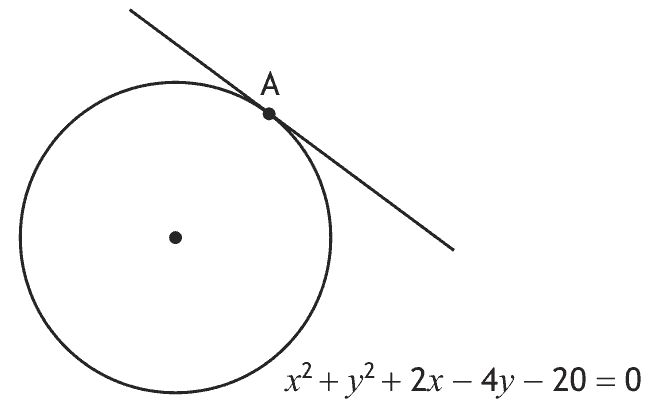
A circle has equation x2+y2+2x4y20=0.\displaystyle x^{2}+y^{2}+2x-4y-20=0.
Point A(2,6) lies on the circle.

Circle with centre marked and the tangent drawn at point A on the circumference

Find the equation of the tangent to the circle at A.

Show answer
3x+4y30=0\displaystyle 3x+4y-30=0
4

Question 4

Apply compound angle formula to simplify or evaluate
(1, 4, 2, 1)8 Marks
2026 P1 Q4

The diagram shows two right-angled triangles with angles p and q as marked.
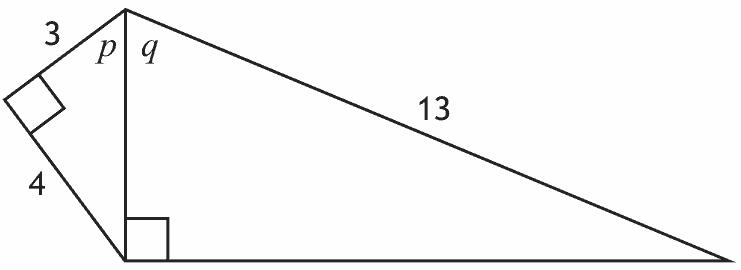
Two right-angled triangles, one with sides 3 and 4 and angle p, the other with sides 13 and angle q

(a)  Determine the exact value of sinq.\displaystyle \sin q.
(b)  Find the exact value of:
    (i)  sin(p+q)\displaystyle \sin(p+q)
    (ii)  cos(p+q).\displaystyle \cos(p+q).
(c)  Hence find the exact value of tan(p+q).\displaystyle \tan(p+q).

Show answer
(a) 1213\displaystyle \frac{12}{13}
(b)(i) 5665\displaystyle \frac{56}{65}
(b)(ii) 3365\displaystyle -\frac{33}{65}
(c) 5633\displaystyle -\frac{56}{33}
5

Question 5

Composite functionsDomain and range
(2, 1, 1)4 Marks
2026 P1 Q5

Functions f and g are defined on R\displaystyle \mathbb{R}, the set of real numbers, by
f(x)=2x2+5\displaystyle f(x)=2x^{2}+5 and g(x)=x+3.\displaystyle g(x)=x+3.
(a)  Find an expression for:
    (i)  f(g(x))\displaystyle f(g(x)) and
    (ii)  g(f(x)).\displaystyle g(f(x)).
(b)  State the range of g(f(x)).\displaystyle g(f(x)).

Show answer
(a)(i) 2x2+12x+23\displaystyle 2x^{2}+12x+23
(a)(ii) 2x2+8\displaystyle 2x^{2}+8
(b) y8\displaystyle y \ge 8
6

Question 6

Vector pathways in geometric diagrams
2 Marks
2026 P1 Q6

ABCD, EFGH is a cuboid.
AB=u\displaystyle \overrightarrow{AB}=\mathbf{u}, BC=v\displaystyle \overrightarrow{BC}=\mathbf{v} and GC=w.\displaystyle \overrightarrow{GC}=\mathbf{w}.
The point M is the mid-point of HG.
The point N divides EA in the ratio 1:2.
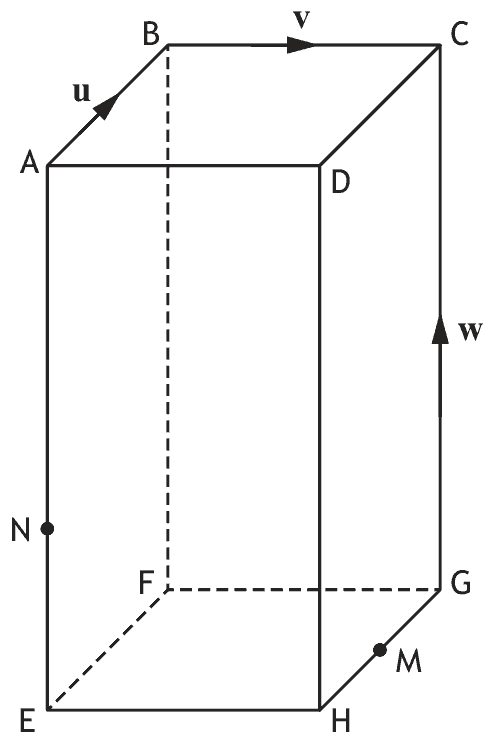
Cuboid ABCD EFGH with vectors u, v and w marked, M the midpoint of HG and N on EA

Express the vector MN\displaystyle \overrightarrow{MN} in terms of u\displaystyle \mathbf{u}, v\displaystyle \mathbf{v} and w.\displaystyle \mathbf{w}.

Show answer
12uv+13w\displaystyle -\frac{1}{2}\mathbf{u}-\mathbf{v}+\frac{1}{3}\mathbf{w}
7

Question 7

Differentiate or evaluate derivative: polynomial
4 Marks
2026 P1 Q7
Determine the gradient of the tangent to the curve with equation
y=2x+4x,\displaystyle y=2x+4\sqrt{x}, x>0\displaystyle x \gt 0
at the point where x=9.\displaystyle x=9.
Show answer
83\displaystyle \frac{8}{3}
8

Question 8

Solving equations containing a logarithm
4 Marks
2026 P1 Q8
Solve log2x+log2(x+2)=3\displaystyle \log_{2}x+\log_{2}(x+2)=3, where x>0.\displaystyle x \gt 0.
Show answer
x=2\displaystyle x=2
9

Question 9

Collinearity (in 3d or 2d)Ratio in which one point divides two others
(3, 2)5 Marks
2026 P1 Q9

(a)  Show that the points D(1,6,1)\displaystyle D(-1,6,1), E(1,2,7)\displaystyle E(1,2,7) and F(2,0,10)\displaystyle F(2,0,10) are collinear.
Point G is such that F divides DG in the ratio 3:4.
(b)  Find the coordinates of G.

Show answer
(a) DE=(246)\displaystyle \overrightarrow{DE}=\begin{pmatrix}2\\ -4\\ 6\end{pmatrix} and EF=(123)\displaystyle \overrightarrow{EF}=\begin{pmatrix}1\\ -2\\ 3\end{pmatrix}, so DE=2EF.\displaystyle \overrightarrow{DE}=2\overrightarrow{EF}.
The vectors are parallel and share the common point E, so D, E and F are collinear.
(b) G(6,8,22)\displaystyle G(6,-8,22)
10

Question 10

Integrate (definite or indefinite): trigonometric expression
4 Marks
2026 P1 Q10
Find
π6π36sin(3xπ2)dx.\displaystyle \int_{\frac{\pi}{6}}^{\frac{\pi}{3}}6\sin\left(3x-\frac{\pi}{2}\right)dx.
Show answer
2
11

Question 11

Cubic/quartic expressions/equations: factorise or solveDiscriminant and Quadratics
(2, 2, 4)8 Marks
2026 P1 Q11

(a)
    (i)  Show that (x+2)\displaystyle (x+2) is a factor of x3+7x2+18x+16.\displaystyle x^{3}+7x^{2}+18x+16.
    (ii)  Explain why (x+2)\displaystyle (x+2) is the only linear factor of x3+7x2+18x+16.\displaystyle x^{3}+7x^{2}+18x+16.
    Give a reason for your answer.
(b)  Find the coordinates of the point(s) where the curves with equations
y=2x3+20x2+27x+9\displaystyle y=2x^{3}+20x^{2}+27x+9 and y=6x29x23\displaystyle y=6x^{2}-9x-23
intersect.

Show answer
(a)(i) Synthetic division by 2\displaystyle -2 gives a remainder of 0\displaystyle 0, so (x+2)\displaystyle (x+2) is a factor.
(a)(ii) The remaining factor is x2+5x+8\displaystyle x^{2}+5x+8, which has discriminant 524(1)(8)=7.\displaystyle 5^{2}-4(1)(8)=-7.
Since the discriminant is negative there are no further real roots, so (x+2)\displaystyle (x+2) is the only linear factor.
(b) (2,19)\displaystyle (-2,19)
12

Question 12

Inverse functionsGraphs of logarithmic or exponential functions
(2, 2, 1)5 Marks
2026 P1 Q12

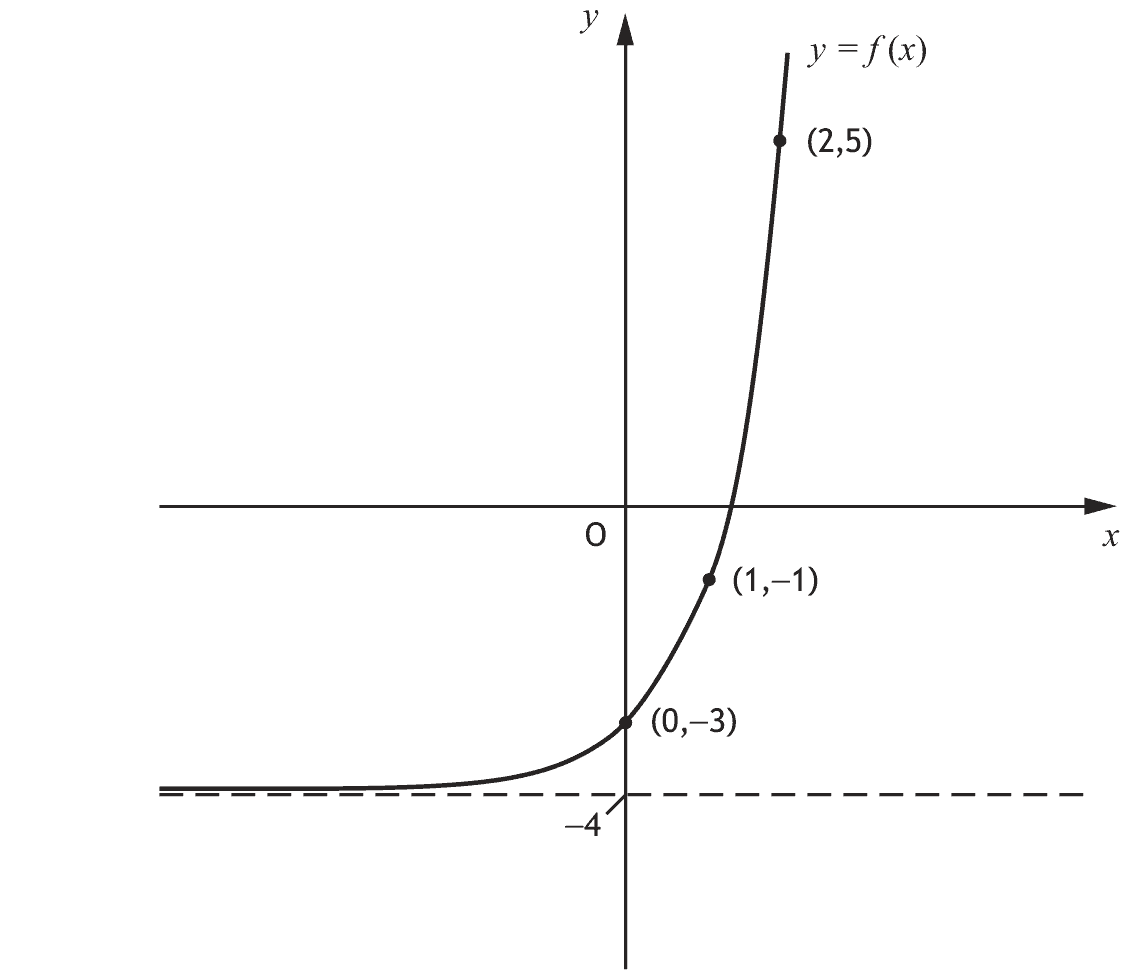
An exponential function, f, is defined for xR.\displaystyle x\in\mathbb{R}.
The diagram shows the graph of y=f(x).\displaystyle y=f(x).

Graph of the exponential function y = f(x) passing through (0, 3), (1, 1) and (2, 5)

The inverse function, f1(x)\displaystyle f^{-1}(x), exists.
(a)  On the diagram in your answer booklet, sketch the graph of the inverse function.
The inverse function is of the form f1(x)=loga(x+b).\displaystyle f^{-1}(x)=\log_{a}(x+b).
(b)
    (i)  Determine the values of a and b.
    (ii)  State the domain of the inverse function, f1(x).\displaystyle f^{-1}(x).

Show answer
(a) The graph of y=f(x)\displaystyle y=f(x) reflected in the line y=x\displaystyle y=x, with a vertical asymptote at x=4\displaystyle x=-4 and passing through (3,0)\displaystyle (-3,0), (1,1)\displaystyle (-1,1) and (5,2).\displaystyle (5,2).
(b)(i) a=3\displaystyle a=3, b=4\displaystyle b=4
(b)(ii) x>4\displaystyle x \gt -4