Functions · Guided Practice

Functions

16 questions with answers and video solutions. Try each one before revealing the answer.

1
Function f\displaystyle f is defined on a suitable domain by f(x)=3xx2−4x−5\displaystyle f(x)=\frac{3x}{x^2-4x-5}.
What values of x\displaystyle x cannot be in the domain of f\displaystyle f?

No hints on this one — its full written solution is with the answer.

2
Function g\displaystyle g is defined on a suitable domain as g(x)=x2+x−12\displaystyle g(x)=\sqrt{x^2+x-12}.
State the largest possible domain of g\displaystyle g.

No hints on this one — its full written solution is with the answer.

3
Function h\displaystyle h is defined by h(x)=1+cos⁡x\displaystyle h(x)=1+\cos x on the domain { x:x∈R, π2⩽x⩽3π2 }\displaystyle \{\,x : x\in \mathbb{R},\,\frac{\pi}{2}\leqslant x\leqslant \frac{3\pi}{2}\,\}.
Identify the range of h\displaystyle h.

No hints on this one — its full written solution is with the answer.

4
Functions f\displaystyle f and g\displaystyle g are defined on R\displaystyle \mathbb{R} by f(x)=1−2x\displaystyle f(x)=1-2x and g(x)=3x2−5\displaystyle g(x)=3x^2-5.
Find and simplify expressions for the composite functions:
(a) f(g(x))\displaystyle f(g(x))
(b) g(f(x))\displaystyle g(f(x))

No hints on this one — its full written solution is with the answer.

5
Function f\displaystyle f is defined on a suitable domain by f(x)=x−1x+1, x≠−1\displaystyle f(x)=\frac{x-1}{x+1},\:x\neq-1.
Find and simplify an expression for f2(x)\displaystyle f^{2}(x).

No hints on this one — its full written solution is with the answer.

6
Functions f\displaystyle f and g\displaystyle g are defined on R\displaystyle \mathbb{R}. The inverse functions f−1\displaystyle f^{-1} and g−1\displaystyle g^{-1} both exist.
(a) Given f(x)=3−2x\displaystyle f(x)=3-2x, find f−1(x)\displaystyle f^{-1}(x).
(b) Given g(4)=5\displaystyle g(4)=5, write down the value of g−1(5)\displaystyle g^{-1}(5).
(c) Write down an expression for g(g−1(x))\displaystyle g(g^{-1}(x)).

No hints on this one — its full written solution is with the answer.

7
The graph of a function f\displaystyle f has turning points at (0, 2)\displaystyle (0,\,2) and (3, −1)\displaystyle (3,\,-1).
State the coordinates of each of these turning points on the following graphs:
(a) y=f(x−3)\displaystyle y=f(x-3)
(b) y=2f(x)\displaystyle y=2f(x)
(c) y=−4f(x+2)\displaystyle y=-4f(x+2)
(d) y=f(3x)−1\displaystyle y=f(3x)-1
(e) y=12f(x)+4\displaystyle y=\frac{1}{2}f(x)+4

No hints on this one — its full written solution is with the answer.

8
2019 P1 Q12
(2, 1)3 Marks

Functions f\displaystyle f and g\displaystyle g are defined by
f(x)=1x\displaystyle f(x)=\frac{1}{\sqrt{x}}, where x>0\displaystyle x \gt 0
and
g(x)=5−x\displaystyle g(x)=5-x, where x∈R.\displaystyle x\in\mathbb{R}.
(a)  Determine an expression for f(g(x)).\displaystyle f(g(x)).
(b)  State the range of values of x\displaystyle x for which f(g(x))\displaystyle f(g(x)) is undefined.

9
2019 P2 Q8
(3, 1)4 Marks

A function, f\displaystyle f, is given by
f(x)=x3+8\displaystyle f(x)=\sqrt[3]{x}+8
The domain of f\displaystyle f is 1≤x≤1000\displaystyle 1\le x\le1000, x∈R\displaystyle x\in\mathbb{R}. The inverse function, f−1\displaystyle f^{-1}, exists.
(a)  Find f−1(x).\displaystyle f^{-1}(x).
(b)  State the domain of f−1.\displaystyle f^{-1}.

10
2022 P1 Q3
3 Marks

A function, h\displaystyle h, is defined by
h(x)=4+13x\displaystyle h(x)=4+\frac{1}{3}x
where x∈R\displaystyle x\in\mathbb{R}.
Find the inverse function, h−1(x)\displaystyle h^{-1}(x).

11
2023 P2 Q6
3 Marks

A function f(x)\displaystyle f(x) is defined by
f(x)=2x+3\displaystyle f(x)=\frac{2}{x}+3 , x>0\displaystyle x \gt 0
Find the inverse function, f−1(x)\displaystyle f^{-1}(x)

12
2024 P1 Q5
3 Marks

A function, h, is defined by
h(x)=2x3−7\displaystyle h(x)=2x^{3}-7
where x∈R.\displaystyle x\in\mathbb{R}.
Find the inverse function, h−1(x).\displaystyle h^{-1}(x).

13
2025 P1 Q5
2 Marks

The diagram shows the graph of y=f(x)\displaystyle y=f(x), with stationary points at (0, 3) and (4, 0).
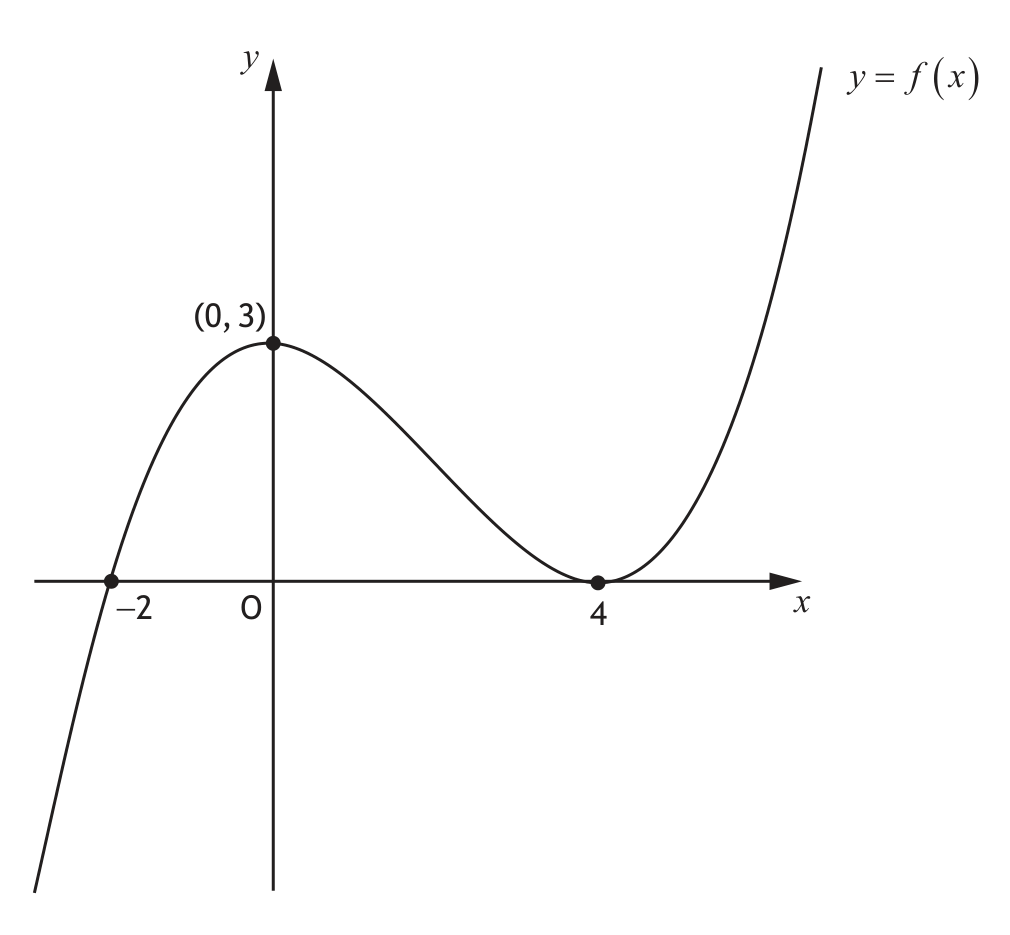
Graph of y=f(x) with stationary points at (0,3) and (4,0)

On the diagram in your answer booklet, sketch the graph of y=f(−x)+3\displaystyle y=f(-x)+3.

14
2025 P2 Q4
3 Marks

A function, g, is defined by g(x)=(x−4)3,\displaystyle g(x)=(x-4)^{3}, where x∈R.\displaystyle x\in\mathbb{R}.
Find the inverse function, g−1(x).\displaystyle g^{-1}(x).

15
2026 P1 Q5
(2, 1, 1)4 Marks

Functions f and g are defined on R\displaystyle \mathbb{R}, the set of real numbers, by
f(x)=2x2+5\displaystyle f(x)=2x^{2}+5 and g(x)=x+3.\displaystyle g(x)=x+3.
(a)  Find an expression for:
    (i)  f(g(x))\displaystyle f(g(x)) and
    (ii)  g(f(x)).\displaystyle g(f(x)).
(b)  State the range of g(f(x)).\displaystyle g(f(x)).

16
2026 P2 Q3
3 Marks
A function, g, is defined on R\displaystyle \mathbb{R}, the set of real numbers, by
g(x)=15x+6.\displaystyle g(x)=\frac{1}{5}x+6.
Find the inverse function, g−1(x).\displaystyle g^{-1}(x).

Practice questions courtesy of Maths.scot. Full written solutions are on his site — the links above go straight to them.