Vectors · Guided Practice

Vectors

23 questions with answers and video solutions. Try each one before revealing the answer.

1
Three vectors are defined as follows: RS→=−3i+2j+k\displaystyle \overrightarrow{\textsf{RS}} = -3\boldsymbol{i}+2\boldsymbol{j}+\boldsymbol{k}, ST→=i−3j+5k\displaystyle \overrightarrow{\textsf{ST}} = \boldsymbol{i}-3\boldsymbol{j}+5\boldsymbol{k}, PT→=2i+j−3k\displaystyle \overrightarrow{\textsf{PT}} = 2\boldsymbol{i}+\boldsymbol{j}-3\boldsymbol{k}.
(a) Find RT→\displaystyle \overrightarrow{\textsf{RT}}.
(b) Hence, or otherwise, find RP→\displaystyle \overrightarrow{\textsf{RP}}.
Video solution coming soon

No hints on this one — its full written solution is with the answer.

2
PQRS is a trapezium with RQ→=2 SP→\displaystyle \overrightarrow{\textsf{RQ}}=2\,\overrightarrow{\textsf{SP}}. Let PQ→=u\displaystyle \overrightarrow{\textsf{PQ}}=\boldsymbol{u} and RQ→=v\displaystyle \overrightarrow{\textsf{RQ}}=\boldsymbol{v}.
(a) Express RP→\displaystyle \overrightarrow{\textsf{RP}} in terms of u\displaystyle \boldsymbol{u} and v\displaystyle \boldsymbol{v}.
(b) Express RS→\displaystyle \overrightarrow{\textsf{RS}} in terms of u\displaystyle \boldsymbol{u} and v\displaystyle \boldsymbol{v}, in its simplest form.
Video solution coming soon

No hints on this one — its full written solution is with the answer.

3
Show that the points A(−1, 3, 0)\displaystyle A(-1,\,3,\,0), B(2, −1, 4)\displaystyle B(2,\,-1,\,4) and C(−7, 11, −8)\displaystyle C(-7,\,11,\,-8) are collinear.
Video solution coming soon

No hints on this one — its full written solution is with the answer.

4
Show that the points P(2, −6, 8)\displaystyle P(2,\,-6,\,8), Q(0, −5, 5)\displaystyle Q(0,\,-5,\,5) and R(8, −9, 0)\displaystyle R(8,\,-9,\,0) are \textit{not} collinear.
Video solution coming soon

No hints on this one — its full written solution is with the answer.

5
(a) Show that the points F(−3, −5, 9)\displaystyle F(-3,\,-5,\,9), G(0, 1, 0)\displaystyle G(0,\,1,\,0) and H(2, 5, −6)\displaystyle H(2,\,5,\,-6) are collinear.
(b) State the ratio in which G divides FH.
Video solution coming soon

No hints on this one — its full written solution is with the answer.

6
A(9, −3, −8)\displaystyle A(9,\,-3,\,-8), B(1, t, 4)\displaystyle B(1,\,t,\,4) and C(−1, 2, 7)\displaystyle C(-1,\,2,\,7) are collinear.
(a) State the ratio in which B divides AC.
(b) Find the value of t\displaystyle t.
Video solution coming soon

No hints on this one — its full written solution is with the answer.

7
R and T are the points (7,−1,8)\displaystyle (7,-1,8) and (−3,4,−7)\displaystyle (-3,4,-7) respectively. S divides RT internally in the ratio 2:3\displaystyle 2:3.
Determine the coordinates of point S.
Video solution coming soon

No hints on this one — its full written solution is with the answer.

8
A and B are the points (−4,1,−3)\displaystyle (-4,1,-3) and (0,−6,1)\displaystyle (0,-6,1) respectively. k AB→\displaystyle k\,\overrightarrow{\textsf{AB}} is a unit vector, where k>0\displaystyle k > 0.
Determine the value of k\displaystyle k.
Video solution coming soon

No hints on this one — its full written solution is with the answer.

9
Vectors u=−3i+2j+nk\displaystyle \boldsymbol{u}=-3\boldsymbol{i}+2\boldsymbol{j}+n\boldsymbol{k} and v=2i+5j+2k\displaystyle \boldsymbol{v}=2\boldsymbol{i}+5\boldsymbol{j}+2\boldsymbol{k} are perpendicular.
Determine the value of n\displaystyle n.
Video solution coming soon

No hints on this one — its full written solution is with the answer.

10
Points A, B and C are (−7, −3, −6)\displaystyle (-7,\,-3,\,-6), (5, −2, 6)\displaystyle (5,\,-2,\,6) and (7, 3, −8)\displaystyle (7,\,3,\,-8) respectively.
Find the angle ∠ABC\displaystyle \angle\textsf{ABC}.
Video solution coming soon

No hints on this one — its full written solution is with the answer.

11
2015 P1 Q1
2 Marks
Vectors
u=8i+2j−k\displaystyle \mathbf{u}=8\mathbf{i}+2\mathbf{j}-\mathbf{k}
and
v=−3i+tj−6k\displaystyle \mathbf{v}=-3\mathbf{i}+t\mathbf{j}-6\mathbf{k}
are perpendicular.
Determine the value of t.\displaystyle t.
12
2018 P2 Q2
(1, 4)5 Marks

Vectors u\displaystyle \mathbf{u} and v\displaystyle \mathbf{v} are defined by
u=(−14−3)\displaystyle \mathbf{u}=\begin{pmatrix}-1\\4\\-3\end{pmatrix} and v=(−785)\displaystyle \mathbf{v}=\begin{pmatrix}-7\\8\\5\end{pmatrix}
(a)  Find u⋅v.\displaystyle \mathbf{u}\cdot\mathbf{v}.
(b)  Calculate the acute angle between u\displaystyle \mathbf{u} and v.\displaystyle \mathbf{v}.

13
2019 P1 Q9
(1, 3, 2)6 Marks

Vectors u\displaystyle \mathbf{u} and v\displaystyle \mathbf{v} have components
(p−24)\displaystyle \begin{pmatrix}p\\-2\\4\end{pmatrix} and (2p+16−36)\displaystyle \begin{pmatrix}2p+16\\-3\\6\end{pmatrix}
p∈R.\displaystyle p\in\mathbb{R}.

(a)  (i) Find an expression for u⋅v.\displaystyle \mathbf{u}\cdot\mathbf{v}.
      (ii) Determine the values of p\displaystyle p for which u\displaystyle \mathbf{u} and v\displaystyle \mathbf{v} are perpendicular.
(b)  Determine the value of p\displaystyle p for which u\displaystyle \mathbf{u} and v\displaystyle \mathbf{v} are parallel.

14
2019 P2 Q14
4 Marks

The vectors u\displaystyle \mathbf{u} and v\displaystyle \mathbf{v} are such that ∣u∣=4\displaystyle |\mathbf{u}|=4, ∣v∣=5\displaystyle |\mathbf{v}|=5 and u⋅(u+v)=21.\displaystyle \mathbf{u}\cdot(\mathbf{u}+\mathbf{v})=21.
Determine the size of the angle between the vectors u\displaystyle \mathbf{u} and v.\displaystyle \mathbf{v}.

15
2021 P1 Q12
Points A, B and C are collinear, with B dividing AC. A has coordinates (4,2,−5)\displaystyle (4,2,-5), B has coordinates (7,−4,1)\displaystyle (7,-4,1), ∣BC→∣=6\displaystyle |\overrightarrow{\textsf{BC}}| = 6.
(a) (i) Find ∣AB→∣\displaystyle |\overrightarrow{\textsf{AB}}|. (ii) State the ratio in which B divides AC.
(b) Determine the coordinates of C.
Video solution coming soon

No hints on this one — its full written solution is with the answer.

16
2021 P2 Q11
(a) Given A(3, 1, 8)\displaystyle A(3,\,1,\,8), B(−2, 5, 1)\displaystyle B(-2,\,5,\,1) and C(7, −6, 3)\displaystyle C(7,\,-6,\,3), express AB→\displaystyle \overrightarrow{\textsf{AB}} and AC→\displaystyle \overrightarrow{\textsf{AC}} in component form.
(b) Hence calculate the size of angle BAC.
Video solution coming soon

No hints on this one — its full written solution is with the answer.

17
2024 P1 Q4
2 Marks

P and Q have coordinates (-6, 1, 2) and (-1, 11, -8) respectively.
Find the coordinates of the point R which divides PQ in the ratio 2:3.

18
2024 P2 Q3
(2, 1, 4)7 Marks

The coordinates of points D, E and F are given by D(2,−3,4)\displaystyle D(2,-3,4), E(1,1,−2)\displaystyle E(1,1,-2) and F(3,2,1).\displaystyle F(3,2,1).
(a)  Express ED→\displaystyle \overrightarrow{ED} and EF→\displaystyle \overrightarrow{EF} in component form.
(b)  (i) Calculate ED→.EF→.\displaystyle \overrightarrow{ED}.\overrightarrow{EF}.
      (ii) Hence, or otherwise, calculate the size of angle DEF.

19
2025 P1 Q10
5 Marks

The vectors u and v are such that:
u=(110)\displaystyle u=\begin{pmatrix}1\\ 1\\ 0\end{pmatrix}
v=(13k)\displaystyle v=\begin{pmatrix}1\\ 3\\ k\end{pmatrix}
the angle between u and v is 45∘\displaystyle 45^{\circ}.
Find the value of k, where k>0\displaystyle k \gt 0.

20
2025 P2 Q5
(3, 1)4 Marks

(a)  Show that the points A(−3,2,−1),\displaystyle A(-3,2,-1), B(6,−1,5)\displaystyle B(6,-1,5) and C(12,−3,9)\displaystyle C(12,-3,9) are collinear.
(b)  State the ratio in which B divides AC.

21
2025 P2 Q8
2 Marks

E,ABCD is a rectangular-based pyramid as shown.
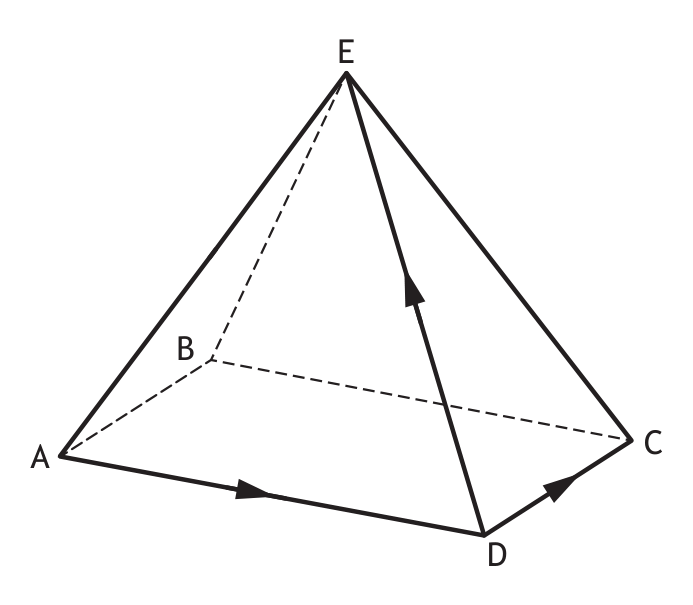
AD⃗=6i+4j+2k\displaystyle \vec{AD}=6i+4j+2k
DC⃗=2i−4j+2k\displaystyle \vec{DC}=2i-4j+2k
DE⃗=−4i−3j+4k\displaystyle \vec{DE}=-4i-3j+4k

Rectangular-based pyramid

Express BE⃗\displaystyle \vec{BE} in terms of i, j and k.

22
2026 P1 Q9
(3, 2)5 Marks

(a)  Show that the points D(−1,6,1)\displaystyle D(-1,6,1), E(1,2,7)\displaystyle E(1,2,7) and F(2,0,10)\displaystyle F(2,0,10) are collinear.
Point G is such that F divides DG in the ratio 3:4.
(b)  Find the coordinates of G.

23
2026 P2 Q2
(1, 4)5 Marks

Vectors u\displaystyle \mathbf{u} and v\displaystyle \mathbf{v} are defined as
u=(326)\displaystyle \mathbf{u}=\begin{pmatrix}3\\ 2\\ 6\end{pmatrix} and v=(−5−24).\displaystyle \mathbf{v}=\begin{pmatrix}-5\\ -2\\ 4\end{pmatrix}.
(a)  Find u⋅v.\displaystyle \mathbf{u}\cdot\mathbf{v}.
(b)  Calculate the acute angle between u\displaystyle \mathbf{u} and v.\displaystyle \mathbf{v}.

Practice questions courtesy of Maths.scot. Full written solutions are on his site — the links above go straight to them.