Measurement & Geometry · Guided Practice
Converting Units
10 questions with answers and video solutions. Try each one before revealing the answer.
(a) km into metres
(b) g into kilograms
Answer
(b) kg
Answer
Answer
Calculate the area of the room in square centimetres.
Answer
Convert miles into kilometres.
Give your answer to 1 decimal place.
Answer
m litres.
Calculate the volume of water in litres.
Answer
Sam drives from Paris in France to Zurich in Switzerland.
He knows:
• his car will cover an average of 47 miles per gallon of fuel
• the fuel tank holds 50 litres of fuel when it is full
• it is 650 km from Paris to Zurich.
| Conversions | |
|---|---|
| 1 mile | |
| 1 gallon | |
Will Sam be able to complete his journey with one full tank of fuel?
Use your working to justify your answer.
Answer
Yes, since 404 miles (or 650 km) is less than the 517 miles (or 832 km) the full tank can cover.
At the weekend, Finlay plans to make a return journey from his home to the shopping centre. He knows:
- the shopping centre is 26 miles away
- his car will cover an average of 67 km per gallon of fuel
- the car has 5 litres of fuel in its tank.
(b) Determine if Finlay will have enough fuel to complete this return journey.
Answer
No, he will only be able to cover 45.8 miles which is less than the 52 miles required.
Steven blew up the tyres on his bike.
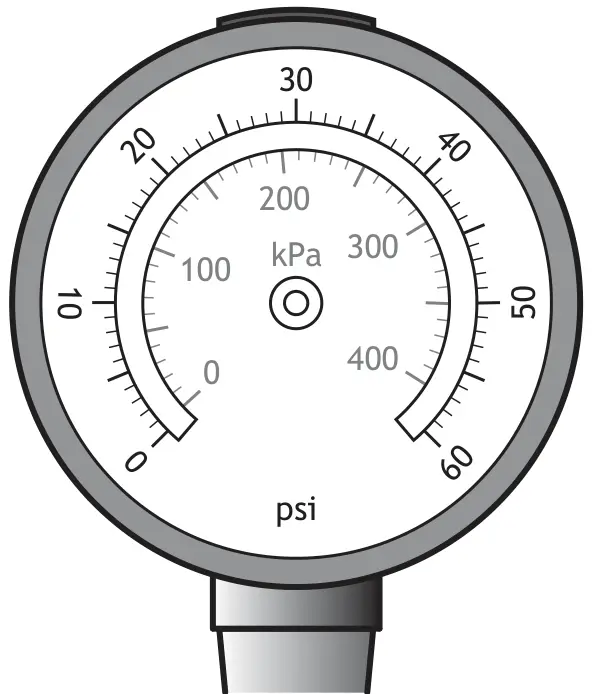
In order to be safe, his tyres should be blown up to a pressure of between 35 and 45 psi.
Steven blew his tyres up to a pressure of 230 kPa.
Determine whether his tyres are at a safe pressure. Justify your answer.
Answer
No, since 230 kPa is approximately 33 psi, which is less than the safe limit of 35 psi. (Alternatively, 35 psi is approximately 241 kPa, and 230 kPa < 241 kPa).
Stephen has built a new ramp.
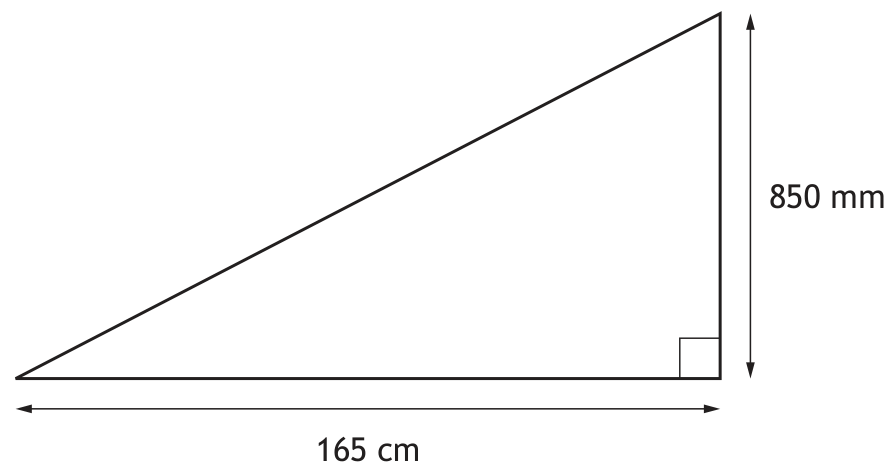
Calculate the gradient of the ramp.
Give your answer as a fraction in its simplest form.
Answer