Geometry · Guided Practice

Vectors

15 questions with answers and video solutions. Try each one before revealing the answer.
1
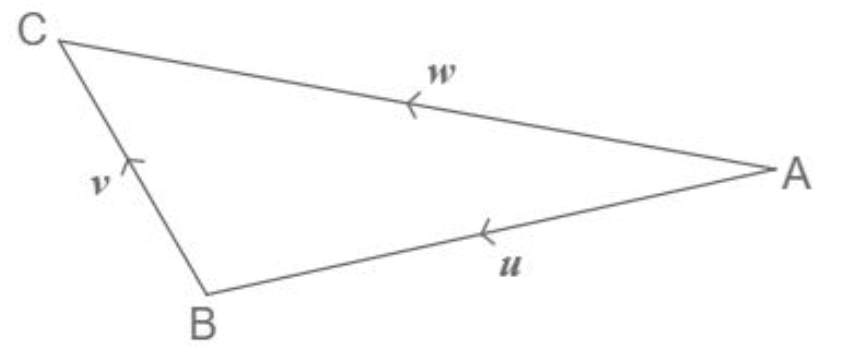
In the diagram below, u\displaystyle \boldsymbol u, v\displaystyle \boldsymbol v and w\displaystyle \boldsymbol w represent AB\displaystyle \overrightarrow{\textsf{AB}}BC\displaystyle \overrightarrow{\textsf{BC}} and AC\displaystyle \overrightarrow{\textsf{AC}} respectively.

Vector diagram of triangle ABC

Express v\displaystyle \boldsymbol v in terms of u\displaystyle \boldsymbol u and w.\displaystyle \boldsymbol w .

2
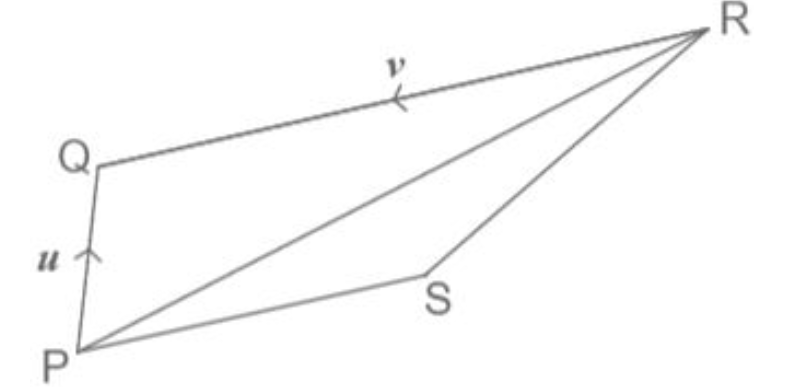
PQRS is a trapezium with RQ=2SP.\displaystyle \overrightarrow{\textsf{RQ}} = 2\overrightarrow{\textsf{SP}} .

PQ\displaystyle \overrightarrow{\textsf{PQ}} and RQ\displaystyle \overrightarrow{\textsf{RQ}} represent vectors u\displaystyle \boldsymbol u and v\displaystyle \boldsymbol v respectively.

Trapezium PQRS with vectors u and v

(a)  Express RP\displaystyle \overrightarrow{\textsf{RP}} in terms of u\displaystyle \boldsymbol u and v.\displaystyle \boldsymbol v .
(b)  Express RS\displaystyle \overrightarrow{\textsf{RS}} in terms of u\displaystyle \boldsymbol u and v.\displaystyle \boldsymbol v . Give your answer in its simplest form.

3
Given u=(45)\displaystyle \boldsymbol u = \left( \begin{matrix} -4 \\ \phantom{-}5 \end{matrix} \right) and  v=(31)\displaystyle \boldsymbol v = \left( \begin{matrix} \phantom{-}3 \\ -1 \end{matrix} \right), find:
  (a) u+vG\displaystyle \:\:\ \boldsymbol u + \boldsymbol v \LARGE \phantom{G} \normalsize
  (b) uvG\displaystyle \:\:\ \boldsymbol u - \boldsymbol v \LARGE \phantom{G} \normalsize
  (c) 2u3vG\displaystyle \:\:\ 2\boldsymbol u - 3\boldsymbol v \LARGE \phantom{G} \normalsize
  (d) 12u+vG\displaystyle \:\:\ \frac{1}{2} \boldsymbol u + \boldsymbol v \LARGE \phantom{G} \normalsize
4
Given p=(321)\displaystyle \boldsymbol p = \left( \begin{matrix} \phantom{-}3 \\ -2 \\ \phantom{-}1 \end{matrix} \right) and  q=(503)\displaystyle \boldsymbol q = \left( \begin{matrix} \phantom{-}5 \\ \phantom{-}0 \\ -3 \end{matrix} \right), find:
  (a) 2pqG\displaystyle \:\:\ 2\boldsymbol p - \boldsymbol q \LARGE \phantom{G} \normalsize
  (b) 12(pq)G\displaystyle \:\:\ \frac{1}{2}\left(\boldsymbol p - \boldsymbol q \right) \LARGE \phantom{G} \normalsize
5
Find v\displaystyle \vert \boldsymbol v \vert, the magnitude of vector v=(4528).\displaystyle \boldsymbol v = \left( \begin{matrix} \phantom{-}45 \\ -28 \end{matrix} \right) .
6
Find r\displaystyle \vert \boldsymbol r \vert, the magnitude of vector r=(8194).\displaystyle \boldsymbol r = \left( \begin{matrix} \phantom{-}8 \\ -19 \\ -4 \end{matrix} \right) .
7
Find ab\displaystyle \vert \boldsymbol a - \boldsymbol b \vert, where a=(.5..6.)\displaystyle \boldsymbol a = \left( \begin{matrix} \phantom{.}5\phantom{.} \\ \phantom{.}6\phantom{.} \\ \end{matrix} \right) and b=(.9..4.).\displaystyle \boldsymbol b = \left( \begin{matrix} \phantom{.}9\phantom{.} \\ \phantom{.}4\phantom{.} \\ \end{matrix} \right) . Express your answer as a surd in its simplest form.
8
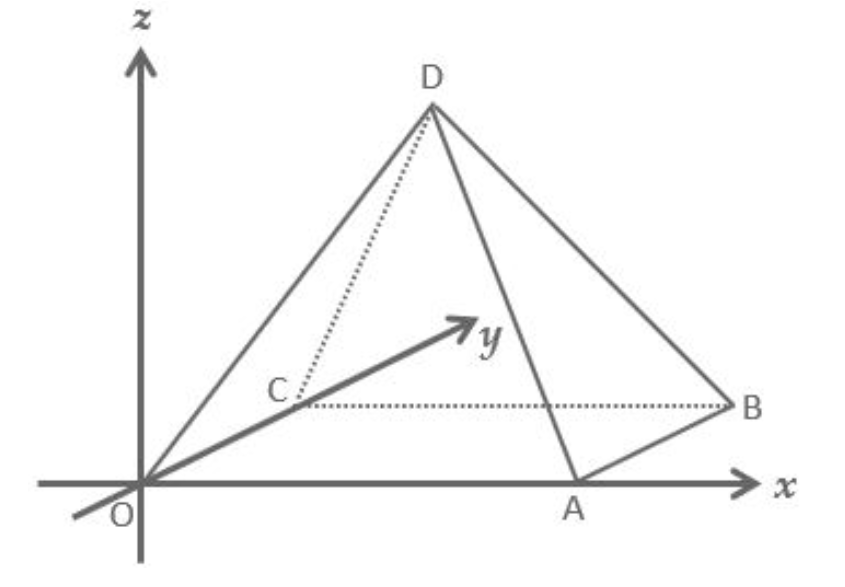
The diagram shows a rectangular-based pyramid, relative to the coordinate axes.

Rectangular-based pyramid in 3D coordinates

B is the point (8,6,0).

The apex D is directly above the centre of the base.

The height of the pyramid is 7 units.

(a) Express AC\displaystyle \overrightarrow{\textsf{AC}} in component form.
(b) Express AD\displaystyle \overrightarrow{\textsf{AD}} in component form.
(c) Determine the exact value of AD.\displaystyle \vert \overrightarrow{\textsf{AD}} \vert.

9
2016 P2 Q3
1 Mark

The diagram below shows parallelogram ABCD.
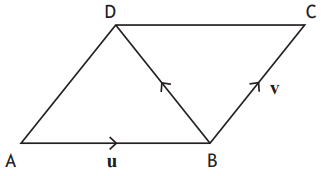
Parallelogram ABCD with vectors u and v

AB\displaystyle \vec{AB} represents vector u\displaystyle \mathbf{u} and BC\displaystyle \vec{BC} represents vector v\displaystyle \mathbf{v}.
Express BD\displaystyle \vec{BD} in terms of u\displaystyle \mathbf{u} and v\displaystyle \mathbf{v}.

10
2018 P2 Q10
2 Marks

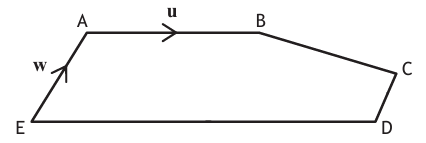
In the diagram below, AB\displaystyle \overrightarrow{AB} and EA\displaystyle \overrightarrow{EA} represent the vectors u\displaystyle \mathbf{u} and w\displaystyle \mathbf{w} respectively.

Vector diagram

ED=2AB\displaystyle \bullet \quad \overrightarrow{ED}=2\overrightarrow{AB}
EA=2DC\displaystyle \bullet \quad \overrightarrow{EA}=2\overrightarrow{DC}
Express BC\displaystyle \overrightarrow{BC} in terms of u\displaystyle \mathbf{u} and w\displaystyle \mathbf{w}.
Give your answer in its simplest form.

11
2019 P1 Q10
(1, 2)3 Marks

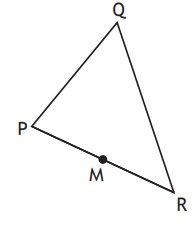
In triangle PQR, PR=(64)\displaystyle \overrightarrow{PR}=\begin{pmatrix}6\\ -4\end{pmatrix} and RQ=(18).\displaystyle \overrightarrow{RQ}=\begin{pmatrix}-1\\ 8\end{pmatrix}.

Triangle PQR vector diagram

(a)  Express PQ\displaystyle \overrightarrow{PQ} in component form.

M is the midpoint of PR.
(b)  Express MQ\displaystyle \overrightarrow{MQ} in component form.

12
2021 P2 Q5

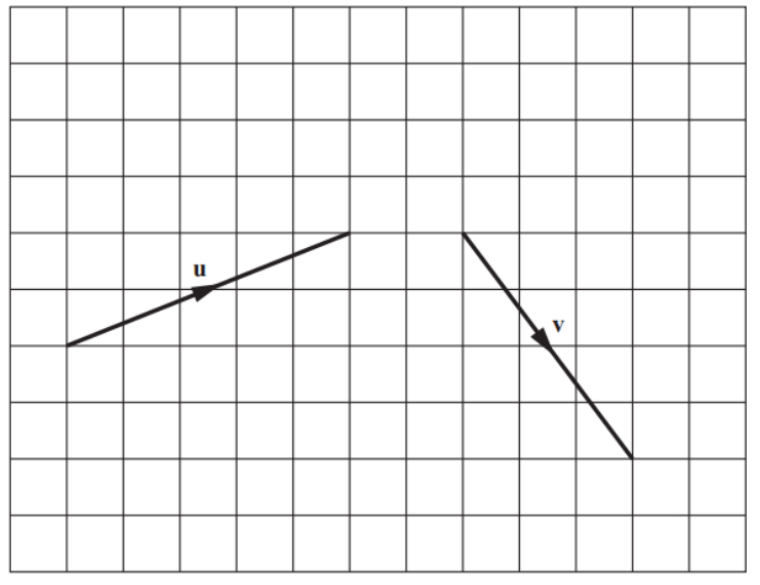
The vectors u\displaystyle \boldsymbol u and v\displaystyle \boldsymbol v are shown in the diagram below.

Vectors u and v on a grid

Find the resultant vector uv.\displaystyle \boldsymbol u - \boldsymbol v.
Express your answer in component form.

13
2021 P2 Q17

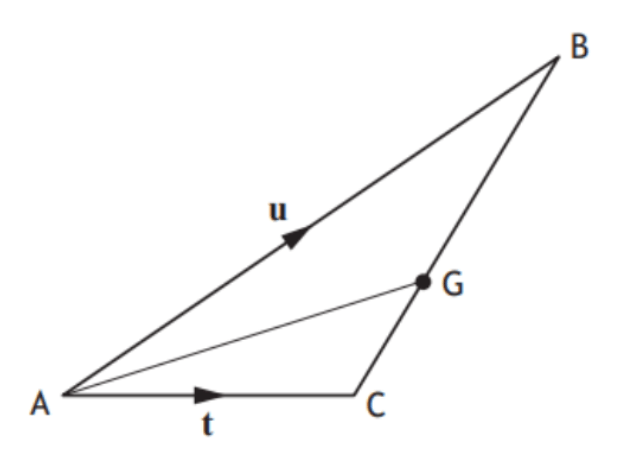
The triangle ABC is shown below

Triangle ABC with point G

AB=u\displaystyle \overrightarrow{\textsf{AB}} =\boldsymbol u and AC=t.\displaystyle \overrightarrow{\textsf{AC}}=\boldsymbol t.
G is the point such that CG = 13\displaystyle \large\frac{1}{3}CB.
Express AG\displaystyle \overrightarrow{\textsf{AG}} in terms of u\displaystyle \boldsymbol u and t.\displaystyle \boldsymbol t.
Give your answer in simplest form.

14
2024 P1 Q4
2 Marks

Given a=(341)\displaystyle \mathbf{a}=\begin{pmatrix}3\\ 4\\ -1\end{pmatrix} and b=(532)\displaystyle \mathbf{b}=\begin{pmatrix}5\\ 3\\ 2\end{pmatrix}, find the resultant vector 3a+b.\displaystyle 3\mathbf{a}+\mathbf{b}.
Express your answer in component form.

15
2026 P1 Q7
3 Marks
Find d\displaystyle |\mathbf{d}|, the magnitude of vector d=(457).\displaystyle \mathbf{d}=\begin{pmatrix}4\\ -5\\ 7\end{pmatrix}.
Express your answer as a surd in its simplest form.

Practice questions courtesy of Maths.scot. Full written solutions are on his site — the links above go straight to them.